
Introduction
Linkage to care (LtC) is the successful completion of a visit with a human immunodeficiency virus (HIV) medical provider within 1 month (30 days) of HIV diagnosis.1 Timely LtC after HIV diagnosis is critical to achieve optimal treatment outcomes and prevent ongoing transmission.2–5 Conversely, delayed LtC has been associated with delayed initiation of antiretroviral therapy (ART), which may lead to delayed viral suppression.6,7 Approximately 80% of people living with HIV (PWH) in the United States are linked to care within one month of diagnosis; of those, only 76% had received some care, 54% were retained in care, and 65% had achieved viral suppression in 2022.8 Reviews from studies showed that timely linkage to HIV care and treatment improved individual and population-level benefits; however, about 25%–31% of newly diagnosed people with HIV were not linked to care.9 Viral suppression (VS) is critical for people diagnosed with HIV infection to improve their quality of life and improve survival, and it is necessary to prevent ongoing transmission.
Early LtC is an essential measure of how well the health care delivery system is functioning and able to provide appropriate and timely medical care for PWH. In addition, LtC is an important step in the cascade of HIV clinical care, as it is the precursor to ART initiation, retention in care, and viral suppression.10,11 Successful LtC will facilitate timely ART initiation and ultimately contribute to the time to achieve viral suppression. On the other hand, delayed LtC delays the initiation of ART. For HIV epidemic control, delayed LtC is a critical gap that needs to be addressed. Evidence from a large study involving 28 United States jurisdictions concluded that people who are linked to care within 30 days have better outcomes—in particular, viral load suppression.12
The goal of the 2020 National HIV/AIDS Strategy (NHAS) was to link 85% of persons diagnosed with HIV to care within 30 days. As a result, our goal was to link 85% of persons diagnosed with HIV in North Carolina to care within 30 days. Additionally, the U.S. HIV National Strategic Plan 2022–2025 sets ambitious targets aimed at ending the HIV epidemic in the United States by 2030.13,14 The plan has set a target to link 95% of persons with newly diagnosed HIV to care within one month. However, there are challenges in the health care delivery system that prevent timely LtC after diagnosis. Early LtC is critical to achieving the downstream goal of 95% suppression among PWH within 6 months with a maintained standard of care and adherence to treatment. Despite progress in controlling the epidemic, there are challenges to maintaining and progressing patients in their care along each stage of the continuum. Cascade losses have been extensively studied and reported.15
LtC is also critical to the achievement of prevention targets. A review of the literature shows that LtC is necessary to reduce the incidence of HIV.16–18 Thus, achieving these targets requires timely LtC and, importantly, the identification of individual and health care delivery factors that impede timely LtC among newly diagnosed individuals. Such health system challenges affect critical steps in the entire “cascade of care”—from diagnosis, laboratory evaluation, treatment initiation, and engagement in HIV care to achieving VS.
In this study, we aimed to investigate the individual and health care delivery factors associated with LtC. Our study analyzed data specifically from residents in Mecklenburg County, North Carolina. Using this data, we sought to answer several specific questions, including: were all individuals diagnosed with HIV linked to care in a timely manner? Which population subgroups had delayed LtC? We anticipated that individual and health care delivery factors would be associated with not achieving LtC. This evaluation was a large local jurisdictional study, which in some ways may represent other high incidence jurisdictions. Furthermore, we believed that Mecklenburg County likely represents many of the Ending the HIV Epidemic (EHE) issues facing other urban centers in the Southeastern United States.19,20
Methods
Data Collection
The North Carolina Department of Public Health (NC DPH) maintains and oversees the Electronic Disease Surveillance System (NC EDSS) and North Carolina-specific Enhanced HIV/AIDS Reporting System (eHARS) databases. The eHARS database captures individual-level data on people diagnosed and living with HIV. Mecklenburg County residents’ data were analyzed.
NC DPH provided Mecklenburg County-specific de-identified eHARS datasets to the study team based on eHARS data with a cut-off of December 31, 2019. These datasets were limited to residents of Mecklenburg County, North Carolina at the time of diagnosis and/or follow-up laboratory viral and CD4 testing. Data records were de-identified so that no personal identifying information remained in the datasets received by the study team.
Study Population and Sample Selection
Because of its high rate of new infections, Mecklenburg County, North Carolina was designated as one of 50 priority jurisdictions identified for the EHE plan.19,20 Charlotte is the principal city in Mecklenburg County and is the second largest city in the Southeastern United States. For this reason, we have examined residents in this jurisdiction using available HIV surveillance data.
Our study examined adults and adolescents older than 13 years whose first HIV-positive diagnostic test was recorded between January 1, 2013, and December 31, 2019, and who lived in Mecklenburg County at the time of their diagnosis, regardless of whether they were linked to care or received care elsewhere subsequently.
Inclusion and Exclusion Criteria
The incidence cohort excluded persons with an HIV diagnosis before January 1, 2013, or after December 31, 2019, and those living in another county at the time of diagnosis (even if they move into Mecklenburg County subsequently). Patients who died and patients not living currently in Mecklenburg County were not excluded from the cohort.
Outcome Measures
Our outcome measure was defined as the number of days between the date of HIV diagnosis assigned in eHARS and the sample date of the first CD4 cell count or viral load (VL) test, calculated as the time from the first diagnosis of HIV (date of first positive test) until LtC, using the date of the CD4 cell count visit or date of first VL as a proxy to determine LtC. LtC was determined to be early if within 30 days after diagnosis (LtC30), delayed (LtC > 30) if it occurred after 30 days, or non-linkage (LtC0) if there were no documented CD4 or VL values. LtC30 was dichotomized with a threshold of ≤ 30 days and > 30 days (including never linked to care).
Primary outcome. For our primary endpoint, we examined the proportions of persons with LtC ≤ 30 days of HIV diagnosis date and examined the associations of demographic and epidemiological factors. We categorized potential factors of suboptimal linkage into individual-level factors and health care delivery factors. Individual-level factors included age, gender, race/ethnicity, sexual orientation, mode of HIV acquisition, and CD4 cell count at diagnosis. Health care delivery factors included diagnostic facility types (e.g., hospital, infectious disease clinic, health department, blood plasma center) and geographic location based on ZIP code tabulation areas.
Secondary outcome. We investigated the geographic distribution of clusters or hotspots of people not achieving LtC30 across ZIP codes in Mecklenburg County, North Carolina.
Study Design
We conducted a retrospective cohort design study using surveillance data for persons diagnosed with HIV in both outpatient care and hospital settings. The dataset analysis was limited to people who were living in Mecklenburg County and diagnosed between 2013 and 2019.
We also investigated if the location of residency (ZIP code) was relevant to the risk assessment using a geographic information system.21 We mapped different ZIP code locations for new diagnoses and those who did not link by 30 days (i.e., LtC > 30), and we compared the difference of associated predictive factors in these subgroups. In addition, we used descriptive analyses and accumulation curves to evaluate LtC30 for the subpopulations in outpatient diagnostic facilities.
Statistical Analysis
Chi-square test of association was used to examine patients’ demographic and epidemiological characteristics of the outcome measure (LtC30). Individuals’ backgrounds and epidemiological characteristics were summarized using proportions. We assessed the proportion of LtC30 and identified significant (P < .05) risk factors associated with LtC30.
For inferential analysis, logistic regression (LR) was used to determine the strength of association between the outcome variable (LtC30) and predictive risk factors. Explanatory variables for the multiple regression model were selected based on clinical knowledge and forward selection from the dataset. The stepwise selection process arrived at a series of LR models, culminating with the final parsimonious model.
Ethical Approval
The University of North Carolina at Charlotte (UNC at Charlotte) Office of Research Protections and Integrity determined that the study did not constitute human subjects research, and according to federal regulations (45 CFR 46.102 [f]) did not require IRB review (IRB letter of 4 Jan 2018, ref #17-0418).
Results
Descriptive Characteristics
Between January 2013 and December 2019, there were 1521 persons (≥ 13 years) newly diagnosed with HIV in Mecklenburg County, North Carolina. The majority (79.5%) were male. Black or African Americans (70%) were the predominant ethnic/racial group, followed by White (14.8%) and Hispanic (11%). Male-to-male sex was the dominant mode of transmission reported (59%). Most patients were diagnosed in physician office clinics (38%), followed by health department testing sites (27%) and hospitals (12%). Table 1 describes the demographic characteristics of newly diagnosed people living with HIV (PWH), according to LtC30 status.
Using univariate analyses, we found that people aged 13–34 years old were less likely to achieve LtC30 than the older age group, and Hispanic patients were less likely to achieve LtC30 when compared to White patients. Patients diagnosed in hospitals, physician offices (clinics), and infectious disease clinics were more likely to achieve LtC30 than patients diagnosed in any other type of diagnostic facility. Patients with lower CD4 counts were more likely to achieve LtC30 than those with high CD4 counts (Table 1).
Overall, 64% (n = 976 / 1521) of all newly diagnosed Mecklenburg County adults and adolescents linked to care within 30 days (i.e., achieved LtC30). Eighty-seven patients were not linked within our observation period of one year after diagnosis.
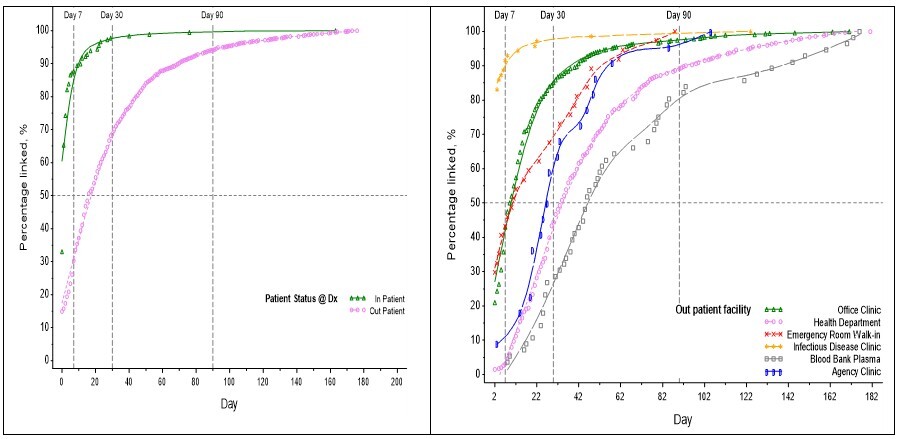
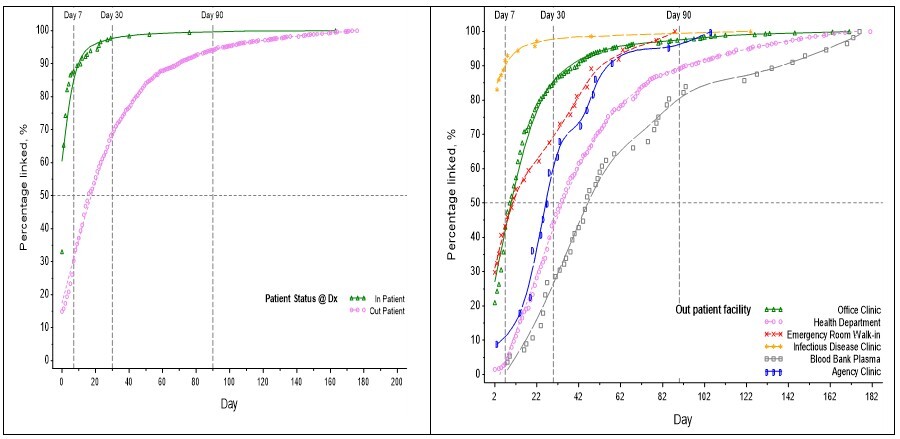
In addition, we explored and plotted a cumulative graph of LtC30 within 6 months of diagnosis (timeframe for standard of care). We also compared and contrasted differences between inpatient and outpatient diagnostic facilities to achieve LtC30. We found that patients diagnosed in hospitals achieved LtC30 earlier than outpatient diagnostic facilities (98% versus 68.8% by 30th day, respectively). These people are likely to be the sickest and represent a subset of PWH. Among outpatient diagnostic facilities, patients diagnosed in infectious disease clinics were linked earlier than in any other outpatient diagnostic facility types (97% linked by day 22). By contrast, those diagnosed in blood banks and plasma centers were linked later than other outpatient facilities; only 28.6% of patients were linked to care by 30 days after diagnosis (Figure 1).
Factors Associated with LtC30
Using univariate logistic regression models, we found potential unadjusted associations of lower proportions of LtC30 occurring among patients first diagnosed in outpatient facilities, males, patients < 35 years of age, persons of color, and persons with higher pre-treatment CD4 cell counts. However, there was no statistically significant association between mode of acquisition and LtC30 (Table 2).
We then applied multivariable logistic regression to calculate adjusted odds ratios (AORs) for factors found in the univariate analyses to be potentially associated with not achieving LtC30. After adjusting for the covariates, we found age category, race/ethnicity, sex, and patient’s diagnostic facility type were significantly associated with not achieving LtC30. After adjusting for the other covariates, the odds of LtC30 were reduced by 0.5 among African Americans, Hispanics, and other race categories compared to White. Similarly, the adjusted odds ratio for men compared to women was 0.61 (AOR = 0.61; 95% CI = 0.41–0.93). When we dichotomized diagnostic facilities into inpatient and outpatient for this analysis, people diagnosed in outpatient facilities were less likely to link to care within 30 days (AOR = 0.08; 95% CI = 0.04, 0.18). Point estimates and associated confidence intervals are reported in Table 3.
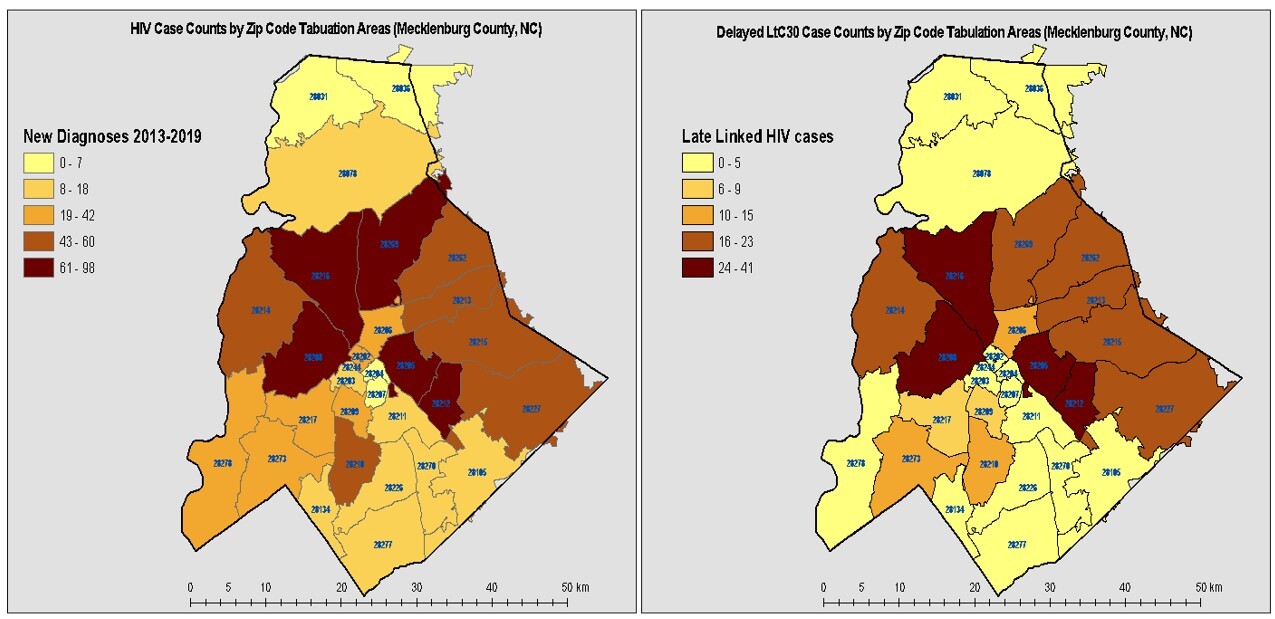
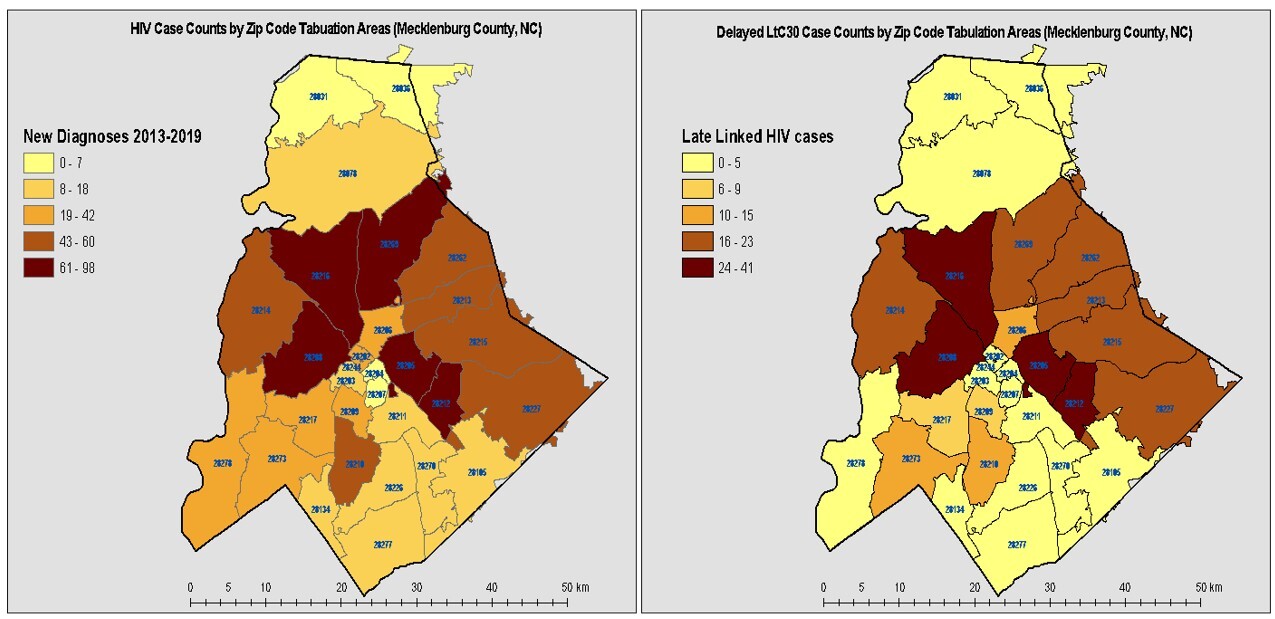
We examined the numbers of incident cases by ZIP code and the numbers of cases of delayed LtC (greater than 30 days for LtC; Figure 2) for Mecklenburg County from 2013–2019. We found that patients with delayed LtC tended to be clustered in specific ZIP codes, and this pattern was similar for high caseloads. The patterns resembled the “arc” and “crescent” pattern previously identified for Mecklenburg County economic and health characteristics.22 A review of the ZIP code tabulation areas showed that the areas not achieving LtC30 corresponded to communities of color.
We georeferenced LtC30 with ZIP code of residence. Charlotte’s “arc” and the “wedge” are spatial patterns that have been used to identify two geographic areas in Charlotte that tend to differ in economic and demographic parameters that may influence social determinants of health. The “arc” described communities of color and concentrated poverty.22 We concluded that social determinants of health are likely to have played a role in these outcome disparities (Figure 2).
Discussion
One of the objectives of the NHAS for PWH is to improve access to care and, as a result, better health outcomes. Access to Care (A2C) was a national HIV LtC program aiming to link and retain the most vulnerable PWH in high-quality HIV care.23 One approach to achieve this objective was through prompt LtC after diagnosis of HIV, which enables immediate treatment initiation. LtC following an HIV diagnosis remains a critical HIV care continuum milestone, even in the era of “test and treat.”24 To increase HIV treatment benefits and achieve viral suppression, interventions are needed for timely LtC, a critical step in the HIV cascade and a precursor to initiating antiretroviral therapy (ART), retention in care, and viral suppression.10 Timely LtC among newly infected people is important to maximize individual-level and population-level ART benefits.25 Achieving the NHAS objective of increasing the proportion of persons with newly diagnosed HIV who are linked to care within one month to 90% will require addressing individual and health care delivery factors associated with not achieving LtC30. US clinical guidelines and the NHAS recommended completing a visit to a medical provider within 30 days of HIV diagnosis as the established metric for LtC. Thus, any visit over 30 days after diagnosis was regarded as a “suboptimal linkage.”
Our study’s analysis examined county-level LtC and investigated the individual and health care delivery factors associated with not achieving LtC30. We used Mecklenburg County-specific eHARS surveillance data and applied univariate and multivariate analyses, finding that only 64% of the adults and adolescents were linked to care within the recommended 30-day period after initial diagnosis. We found several important individual and health care delivery factors influencing suboptimal linkage. Racial and ethnic minority status, defined as Black or African American, Hispanic, or a member of another racial minority group, was associated with lower proportions of LtC30. Young adults, particularly those in the age group 13–34 years, had lower linkage rates.
Unsuccessful or delayed LtC deprives adolescents living with HIV of the benefits of HIV treatment, risks increased HIV transmission, and risks increased HIV-related morbidity and mortality.26,27 A 2009 national survey revealed that health care providers more often attributed non-engagement in care to structural barriers (finances, transportation, family care, lack of time off from work, and substance use). PWH often reported psychosocial issues (stigma, concern about medication side effects, and shame) as the most important barriers to care.28 Additionally, barriers such as inconvenient location of medical services and long appointment wait times likely contribute to delayed LtC. Persons required to test for HIV (e.g., for insurance, employment, or court-ordered purposes) were found to delay linkage after receiving a diagnosis of HIV, compared to those who self-initiate testing or those offered testing by health care providers through provider-initiated HIV testing.29
Furthermore, we found that patients with suboptimal linkage were clustered in particular ZIP codes in Mecklenburg County. Our analysis did not include a thorough assessment of the reasons for this clustering and, as such, calls for more detailed inquiry. The clustering of people who did not link could reflect accessibility challenges beyond the scope of our analysis. Disparities in care access by racial and socioeconomic groups have been previously documented by other researchers30 and call for strengthening the health system31 to support population subgroups disproportionately impacted by poor access to care. Fitting the map to describe the “arc” and the “wedge,” the areas of high counts of HIV diagnoses and high counts of not achieving LtC30 were consistent with the “arc,” where households were more densely populated (about 48% of the total city population), the average income was below the city average, and 67% of the population consisted of minoritized groups. By contrast, areas of low HIV incidence and achieving LtC30 corresponded to the “wedge,” where the residents were 31% of the total city population, the average income was above the city average, and the majority of the population was White (63%).
It is important to recognize that the LtC data in this study were from the pre-EHE era and fell short of current EHE county goals. EHE-driven changes to HIV care goals and processes with the intent of improving patient linkage to care have been made since the collection of these data.
From a structural perspective, further studies might be needed to assess the impact of health insurance on LtC and other social determinants of health to better understand suboptimal LtC in the affected communities. For young adults with suboptimal LtC, novel ideas like leveraging mobile health interventions, including using a mobile phone-enabled application to improve linkage to HIV care, may be helpful.15 Overall, epidemic control will require aggressive LtC interventions through a concerted effort from individuals, HIV providers, HIV-engaged agencies, and the county government. We also found that facilities where patients were diagnosed had an effect on LtC, with outpatient offices being associated with lower linkage. As a result, strategies to facilitate LtC should be pursued.
Limitations
Our study had limitations. First, we used routine surveillance data collected at the time of HIV diagnosis and follow-up reported encounters. Important data elements such as health insurance, socioeconomic status, education, and employment status that influences linkage and health care access were not available. In addition, many other person-level factors such as education, privacy concerns, mental health issues, family support, and perhaps knowledge and beliefs about HIV/ AIDS that may impact the time between the diagnosis and the link to care were not available in the dataset.
Moreover, the surveillance data are subject to errors in reporting and missing information. CD4 and viral load test sample dates are taken as the epidemiological marker for linkage but do not speak to the start and maintenance of treatment. However, evidence of retention in care and effectiveness of therapy can be extrapolated from examination of viral loads over time and alternative sources of evidence of ART. This was beyond the scope of our current study.
Conclusion
In conclusion, we found suboptimal LtC30, especially among Black and Hispanic populations and young adults aged 13–34 years in Mecklenburg County during 2013–2019. To improve LtC and achieve the national strategic plan objective, improvements will be necessary at the health-care-delivery level to reach the 36% who linked late and those who did not link at all. Our study identified patients’ risk profiles that may be targeted to improve LtC, treatment outcomes, and to control the epidemic.
Acknowledgments
The authors thank Erika Samoff, Jason Maxwell, and John Barnhart of the North Carolina Department of Public Health, HIV/STD/Hepatitis Division, Raleigh, NC for providing the data and advice. We also thank Donna Smith and Alexia Williams of the Epidemiology Division and Matthew Jenkins of the HIV/STD Division, Mecklenburg County Public Health Department, Charlotte, NC for their advice and support on this project. We thank the Academy for Population Health and Innovation (APHI) of University of North Carolina at Charlotte for logistical support.
Disclosure of Interests
The authors of this manuscript do not have research support from any funding sources and do not hold stock in, serve on an advisory board for, serve on the Board of Directors of, and/or have not received an honorarium from any entity. The terms of this arrangement have been reviewed and approved by the University of North Carolina at Charlotte in accordance with its policy on objectivity in research.
Correspondence
Address correspondence to Dr. Yakubu Owolabi (yaks.owolabi@gmail.com).