Introduction
Rurality is a subjective concept, meaning different things to different people. It is multifaceted, capturing population density, remoteness, and access to services, but may be internalized as a lifestyle, a feeling, or a way of being. Importantly, in health policy, when we talk about rurality, we are speaking inherently about people and their experience—but this is really hard to measure. So instead, we do the next best thing and define the area, not the people. And there is no single “right” way to draw these areas; federal and state agencies use many different definitions with different results as to who is considered rural.
Who is counted as rural varies across definitions—and not just how many, but their makeup. This is especially important in North Carolina, which, according to some definitions, has one of the largest rural populations in the country.1 With rural people living across the state, from the Blue Ridge Mountains across to the outer reaches of Cape Hatteras, its rural population is heterogenous. Rural North Carolina boasts a rich expanse of geography, history, industry, language, race, and culture. It is in fact this richness that makes it inherently challenging to define “rural” across one or two dimensions.
When policy and programs distribute fixed resources, with eligibility determined by rurality, who can apply (and consequently the level of competition) has real-world impacts on whether programs can reach the types of communities for which they were designed. Recent investments, such as the Rural Health Transformation Program (RHTP), bring the practical effects of these choices to light. In particular, North Carolina’s regionalized implementation of the RHTP through the 6 Rural Organizations Orchestrating Transformation for Sustainability (ROOTS) Hubs is an opportunity to be intentional about definitions of rural that fit each region but remain harmonized with state-level work. In this piece, we briefly review some commonly used federal and state definitions of “rural” and discuss implications for policy and health services planning.
Why Does It Matter How We Define Rural?
Health care access, and consequently outcomes, are often worse in rural areas than urban areas. Rural North Carolinians experience longer travel times to access health care,2 and there is heterogeneity within rural populations, such that some (including those who are pregnant, veterans, or American Indian and Alaska Natives) may experience additional barriers to accessing needed care.3 This increased travel time and other added barriers to care may result in delayed or deferred care and increased risk of adverse health outcomes.4 The persistent trend of rural hospital closures exacerbates this access challenge for many communities.5–7
State and federal governments have aimed to address these gaps through policy and funding opportunities that are made available to rural communities. Thus, designation as “rural” can determine eligibility for several federal and state programs. Most recently, North Carolina received $213 million through the RHTP to spend in the initial year of its 5-year program to transform the rural health system in North Carolina. The allocations to states were based on a variety of formulas based on different rural factors used by the federal government.
Rural Definitions
There are many different definitions of rural used by health policy makers and researchers.8,9 Selecting the appropriate definition for a given policy or program requires careful attention to its purpose and the implications of using one measure over another. Detailed guidance for researchers selecting a rural definition has been outlined in prior work9,10; here we focus specifically on North Carolina, reviewing a handful of common federal and state definitions operationalized in the state. Table 1 presents five federal and three state definitions of rurality.
Perhaps the most common is the Office of Management and Budget’s (OMB’s) Combined Statistical Area—Metropolitan and Micropolitan. Interestingly, OMB specifically notes that this definition should not be used for rurality,11 but many federal programs—and even other definitions—start with Metropolitan as the primary rural definition.14 Many of these definitions were created to address a problem or capture a different facet of rurality that was not captured in prior definitions. For example, Rural-Urban Commuting Area (RUCA) codes were created to define rurality at finer spatial units of census tracts and ZIP codes, in recognition that definitions that are based on counties, such as Rural-Urban Continuum codes (RUCCs), may mask some of the heterogeneity within counties.12,13 Counties are large, and there are some areas of “urban counties” that are more rural. Johnston, Chatham, and Union counties, where the east and west portions are pretty different, are classic examples in North Carolina; the Grand Canyon, located in metropolitan Coconino County, Arizona, is a national example. Additionally, Frontier and Remote area (FAR) codes allow for further classification of remoteness in terms of travel time to accessing services, while the Federal Office of Rural Health Policy (FORHP) combines several other federal definitions and considers road ruggedness—the degree to which a road is “winding.”14,15
Additionally, there are several state-specific definitions, including those from the North Carolina Department of Health and Human Services Office of Rural Health (ORH), the NC Rural Center, and North Carolina’s RHTP application. The ORH considers counties rural if they are not a central county of a Metropolitan Core-Based Statistical Area (designations created by the Office of Management and Budget).16 NC Rural Center’s definition is based on population density.17 Finally, in fall of 2025, the state applied for funding through the Centers for Medicare & Medicaid’s RHTP. The application used an expansive definition of rural, recognizing that there are rural areas within many urban counties by designating the 85 counties with at least one rural census tract as rural.18
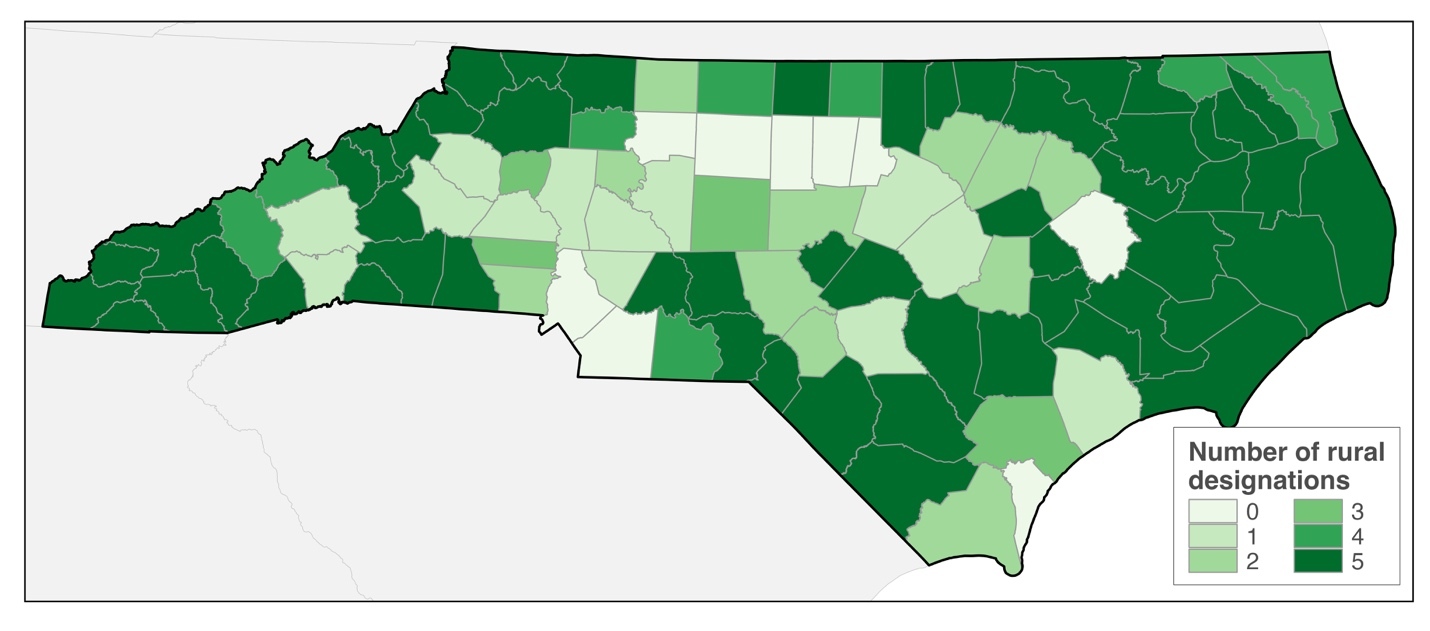
Given the variety in the classification criteria, some areas may be considered rural under some definitions and urban under others. Figure 1 is a map of North Carolina, with the shading indicating the number of definitions that designate that area as rural. The darkest shading indicates that the area is consistently rural across all considered definitions, and the lightest shading indicates that none of the included definitions classified the county as rural.
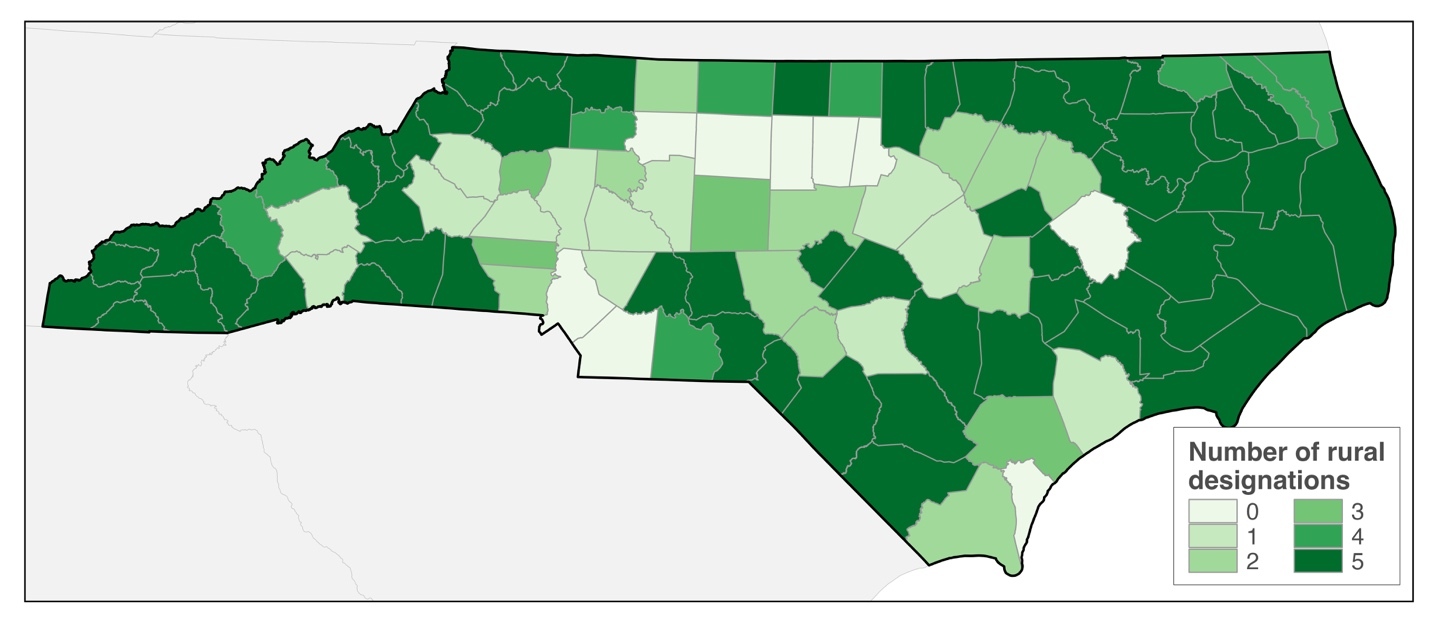
The 5 county-level rural definitions included on this map range from 55 North Carolina counties (RUCC) up to 85 (North Carolina’s RHTP application). Note that some counties that many people would probably consider rural (e.g., Madison County) are urban in at least one definition. This underlines how critical it is to consider which definition is most appropriate for the application. For example, is the issue isolation/distance (e.g., distance to nearest oncologist or four-year college) or the local population size (e.g., access to primary care or a grocery store)?
Challenges of Rural Definitions: Handle With Care When Putting Me in a Box
The set of rural definitions and how they are constructed are important tools for rural health policy, practice, and research, but we don’t always talk about the relative strengths and weaknesses of each.
Rurality is continuous, even though definitions are often binary or discrete. Just as there is no clear line between fresh and salt water where they mingle in brackish Pamlico Sound, there is no stark divide between urban and rural, where skyscrapers give way to bucolic rolling forests.
Units of geography are internally heterogenous. All definitions use some sort of geographic area (e.g., county or census tract) to define rurality. But no matter how small the areal unit, it will vary in its “ruralness.” For example, counties are large geographic units; thus, one county can contain farmland and dense urban environment, and the designation of the entire county as either rural or urban is an oversimplification that leaves some areas with a designation incongruent with the local environment (some rural areas found inside urban counties and vice versa). Even with smaller units, the same problem exists, just on a smaller scale. While continuous measures of rurality exist (e.g., the Index of Relative Rurality), they are not widely adopted.19
Designations change over time. Even within one definition, the criteria for rural designation may change over time. For example, in 2020, the United States Census Bureau changed its criteria for rural census block classification from a density of less than 2500 people to less than 5000 people or 2000 housing units.20 Additionally, even under continuous definitions, a county’s designation may change due to a growing or shrinking population and access to services. As an example, in North Carolina between 2013 and 2023, under OMB’s definition, four North Carolina counties changed from metro to non-metro (Haywood, Craven, Jones, and Pamlico), while three changed from non-metro to metro (Anson, Moore, and Camden).21 Under the NC Rural Center’s definition, two different counties were reclassified from rural to urban (Johnston and Onslow) between 2010 and 2020.22
Rural is more than not urban. Another limitation of most rural definitions is the construction of rural as the residual—anywhere that is not urban. Using definitions that have this deficit framework may inadvertently perpetuate the practice of designing policy and programs for urban and retrofit to rural, rather than designing with and for rural. Prior work has suggested an index of rurality that would incorporate rural assets, going beyond population and geographic accessibility to capture other resources, amenities, socioeconomics, and local perception and culture.10
Understanding who is counted where matters. Some communities are persistently undercounted in the census, including those who are Black or African American, American Indian and Alaska Native living on reservations, Hispanic or Latino, and renters. Undercounting happens for a variety of reasons including limited access (driven by language, technological, or medical barriers), high mobility, and eroded trust.23 Persistent undercounting may shape the designation and mask demographic diversity of rural communities.
Rurality is best defined in terms of core principles, not proxies. Rurality is a geographic concept and may be measured using slightly different metrics that incorporate that concept (e.g., density, distance and/or connection to urban areas). Definitions that incorporate factors associated with rural living—such as income or access to health care—are less about rurality per se and more about other concepts. That may be appropriate for the specific application, but these other concepts extend beyond the boundaries of rurality. As an example, Health Professional Shortage Areas (HPSA) directly measure the population per physician. It is well known that this ratio is higher in rural areas, but this measure is more appropriate than rurality per se for HPSA-based interventions.
Definitions do not always align with perception. In a 2017 US Department of Housing and Urban Development survey, respondents described their neighborhood differently from formal definitions. Census-based classifications and residents’ perceptions of rurality diverged considerably, with more than 20% of respondents self-classifying their neighborhoods differently than the Census designation. Disagreement was greatest in the South Atlantic region. In Charlotte, the only North Carolina city identified, 76.8% of households classified their neighborhood as suburban or rural.24 These findings reiterate that applying rural designations in North Carolina requires careful attention to their limitations: the objective measure may differ from the subjective view of the residents.
In Practice: Considerations for Uncovering an Appropriate Rural Definition
Despite the continuum of rurality and geography, policy often requires a discrete definition in order to define who is eligible for rural-focused funding, services, and programming. Building on Bennett and colleagues, Table 2 presents tradeoffs to consider when selecting a definition, including the dimension or rurality relevant to the program, existing data availability, and intended harmonization with other programs.
Additionally, we note there are different implications of choosing an expansive definition versus narrow definition. In a competitive application process with fixed funding, using too narrow a definition of rural (especially one defined at the county level) risks excluding rural areas in urban counties that may benefit. However, using an expansive definition, entities with better resources—often larger and more likely to be urban—may be more competitive and thus crowd out more rural applications. One example is eligibility for National Health Service Corps placements. With a broad eligibility criterion, and more eligible sites than available awards, sites with greatest workforce needs may have more challenges in recruiting. Because 80% of the funding is directed through loan repayment (as opposed to scholarships) to workforce already practicing in HPSAs, sites that have trouble recruiting (often due to limited resources) lack access to the majority of the funding through this mechanism.25
Uncover rather than ascribe a rural definition. A common saying in management is, “show me your budget, and I’ll tell you your organization’s priorities.” In the same way, review a program’s rural definition, and one can tell what its implementers believe constitutes rural need. For example, a telehealth program for specialty care may be best suited for isolated communities, so a definition that leverages that may be more appropriate than a population density-based measure. Choosing a definition, therefore, is not just a technical exercise; the program’s intent and thus community needs must be understood from the beginning.
Conclusion
Rural North Carolina is defined by the people and the places they live, and no single definition captures this richness. Yet, definitions of rurality determine who is eligible, who is counted, and who is served. Thus, the choice of rural definition is a critical success factor for a program or policy and should be deliberate and thoughtful. Due to the definitions’ limitations, lines will fall imperfectly in the task of fencing communities into rural and non-rural. Without careful attention to how rural definitions are constructed and where they break down, the communities shaped by the deepest disinvestment are those most likely to go unserved.
Acknowledgements
Susie Gurzenda acknowledges support by NICHD of the National Institutes of Health under award number P2C HD050924 and T32HD007168 Population Science Training Grant.
During the production of this article, authors used AI to support coding of the data visualizations (GitHub Copilot) and to review a draft for ethical concerns and completeness (Claude). After using these tools, the authors reviewed and edited the content as needed. There is no AI-generated manuscript language, other than some suggested revisions during review, which were subsequently reviewed and edited, if needed. Authors take full responsibility for the final publication.
Declaration of Interests
The authors have no conflicts of interest.
Correspondence
Address correspondence to Susie Gurzenda, 725 Martin Luther King Jr. Blvd, Chapel Hill, NC 27599-7590 (susie_gurzenda@unc.edu).