
Introduction
In recent decades, vector-borne infectious disease incidence has tripled in the United States.1,2 Despite this increase, many regions across the United States lack adequate public health infrastructure, mosquito surveillance and control capacity, and invasive vector detection capabilities.3–5 In North Carolina, the primary causes of endemic mosquito-borne disease are La Crosse, eastern equine encephalitis (EEE), and West Nile viruses. In most years, La Crosse encephalitis (LACE) accounts for the largest burden of endemic mosquito-borne disease in the state.6,7 Notably, LACE disproportionately impacts children, with a median case age of 9 years.7 During the past two decades, persistent spatial clusters of LACE have been identified in Western North Carolina (WNC) counties.8
La Crosse virus (LACV) is an arbovirus in the genus Orthobunyavirus and a member of California serogroup (CSG) of viruses. The CSG contains 18 viruses, including species such as Jamestown Canyon virus that overlaps geographically and is antigenically similar, resulting in cross-reactivity for some diagnostic methods.9,10 The disease ecology of LACV is complex. The virus is primarily transmitted by the eastern tree hole mosquito (Aedes triseriatus), although two invasive mosquito species (Aedes albopictus and Aedes japonicus) are likely secondary vectors.11 Horizontal transmission includes virus-amplifying hosts such as chipmunks and squirrels (family Sciuridae).12 Humans are “dead end” hosts as they do not appear to have detectable viremias that are able to infect host-feeding mosquitoes. Importantly, LACV can be vertically transmitted from a female mosquito to her offspring via transovarial infection, which likely leads to the spatial persistence of the virus over decades.13,14
From a national perspective, LACE is rare.2 However, in areas of Appalachia where the disease is endemic, the relative risk of disease in high-risk clusters can be 23 to 70 times higher than non-endemic counties.15 From 2003–2021, the risk of LACE was approximately 44 to 53 times higher in WNC high-risk clusters than in non-endemic counties, clearly demonstrating the regional importance of this disease. During 2000–2021, there were 355 confirmed or probable cases of LACE reported in North Carolina, with most (92%) occurring in the 19 western-most counties of North Carolina.7 These confirmed or probable cases (i.e., those meeting the national case definition) represent only the “tip of the iceberg” in terms of actual human exposure to LACV.
Additionally, the need for paired or convalescent serologic testing in the case definition likely limits accurate identification of some individuals with clinically apparent LACV disease. Serological evidence indicates that most LACV infections go unrecognized, with estimates suggesting that for every reported LACE case, there may be between 100 and 300 undetected LACV infections in humans.16 Similarly, previous serological studies in WNC found that approximately 1 in 10 individuals with no history of LACE had been exposed to LACV.17
Acute LACE often manifests with fever, headache, altered mental status, gait disturbance, and seizures.7 Although the case fatality rate of LACE (~1%–2%) is low, the potential direct and indirect medical costs from hospitalization and long-term neurological sequelae, including neurobehavioral impacts, are significant.18,19 Furthermore, emerging evidence suggests that the risk of LACE may persist at the household level for years.20 In some instances, siblings living at the same residence have been diagnosed with LACE years apart, indicating that a public health response (i.e., arboviral disease case investigations) should be initiated following the first reported case.20,21
The significant public health impact of LACE in WNC, along with the burden of other endemic mosquito-borne diseases and the risk of travel-related illnesses such as dengue and malaria, underscores the need for organized mosquito surveillance, standardized case response, and robust control capacity in counties across the region. However, mosquito-borne disease control capacity in WNC, where LACE is endemic, is poorly known. The primary goal of this study was to assess the perceptions, knowledge, preparedness, and capacity of local health department personnel across the 10 counties in WNC with the highest incidence of LACE. In doing so, we sought to identify opportunities to inform future resource allocation and improve public health response capacity specifically as it relates to La Crosse virus disease.
Methods
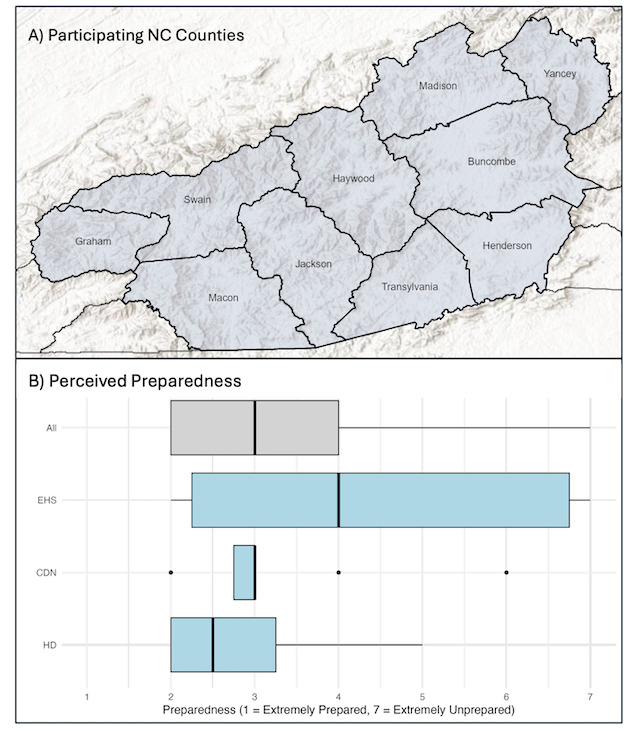
This study employed a cross-sectional survey to assess knowledge of vector-borne diseases and control capacity in 10 county-based health departments in WNC (Figure 1). These counties had the highest cumulative incidence of La Crosse encephalitis between 2000 and 2020.7 The primary data collection tool was an electronic survey developed using SurveyMonkey© software (San Mateo, CA). The survey contained 80 total items, including a combination of core questions administered to all participants and role-specific questions tailored to health directors, environmental health specialists, or communicable disease nurses. No individual respondent completed more than 32 questions. The full survey instrument is available from the corresponding author upon request.
_map_of_the_study_area__participating_western_north_carolina_counties_with_the_highest_c.png)
The survey assessed vector-borne disease knowledge, perceptions of public health relevance, and existing mosquito surveillance and control capacity. Survey content assessing control capacity was structured around core and supplemental competencies recognized by the Centers for Disease Control and Prevention (CDC) and adapted from the National Association of County and City Health Officials (NACCHO) framework for mosquito control programs.5 Because LACV is the most common mosquito-borne pathogen causing human disease in WNC, the scope of the survey was primarily focused on LACV and mosquito-borne disease response instead of other vector-borne diseases.
The Office of Human Research Ethics at the University of North Carolina at Chapel Hill determined that this study did not meet the federal definition of human subjects research [45 CFR 46.102(e) or (l); 21 CFR 56.102(c), (e), or (l)] and therefore did not require Institutional Review Board (IRB) approval.
Participants included health department directors, communicable disease nurses (CDNs), and registered environmental health specialists or interns (EHS). These specific job roles were selected as they have clearly defined roles as part of the public health response to “arboviral encephalitis/meningitis” as described in the local health department investigation steps within the North Carolina Communicable Disease Manual.22 Potential respondents were identified through a review of health department websites, the North Carolina State Board of Environmental Health Specialist Examiners registry, and professional contacts. The survey was distributed via email to 128 verified email addresses (10 health department directors, 18 CDNs, and 100 EHS). The survey remained open for 4 weeks (February 2024–March 2024), during which two reminder emails and follow-up phone calls were used to encourage participation.
Quantitative data were analyzed using descriptive statistics and contingency tables to compare vector-borne disease preparedness across roles. Basic data analyses (e.g., descriptive and summary statistics) were performed within the SurveyMonkey© website directly or exported to a .csv file for analyses using R/RStudio.23 Confidence intervals were calculated using the exact binomial method. Significance was defined a priori as P < .05 for all statistical tests. For paired ranking data, a global Friedman test was conducted first. When the Friedman test was statistically significant, pairwise Wilcoxon signed-rank tests were performed. Data visualizations and graphs were created using ggplot2 in R/RStudio.24
Results
Response Rates
The survey was distributed via email to 128 public health staff across 10 WNC local health departments. Of these, 62 individuals initiated the survey, and 60 individuals acknowledged the consent statement and identified their professional role as either a health director, environmental health specialist (EHS), or communicable disease nurse (CDN). Within individual counties, the number of respondents initiating the survey ranged from 2 to 12, (median: 6; mean: 6.7). A total of 47 participants completed the survey in full, resulting in an overall response rate of 36.7%. Public health personnel from all 10 health departments completed the survey, including 8 health directors, 23 EHS personnel, and 16 CDNs (the CDNs include 2 respondents that identified as public health nurses with communicable disease reporting or investigation responsibilities). Overall survey completion rates for specific job roles varied (80% of health directors, 23% of EHS, and 84.2% of CDNs); because individuals were allowed to skip questions during the survey, the responses to any single question may not equal the total number of participants.
Health Department Preparedness to Respond to Mosquito-Borne Diseases
Respondents ranked their health department’s level of preparedness to respond to mosquito-borne disease cases, where 1 = extremely prepared, 2 = very prepared, 3 = somewhat prepared, 4 = unsure, 5 = somewhat unprepared, 6 = very unprepared, and 7 = extremely unprepared. Overall (N = 46), the median response was 3 (somewhat prepared) (mean: 3.63; range 2–7) (Figure 1). Although health directors responded more favorably (median: 2.5; mean: 2.9; range 2–5) and EHS personnel responded less favorably (median: 4; mean: 4.3; range 2–7), these differences were not statistically significant.
Perceived Relative Importance of Mosquito-Borne Diseases
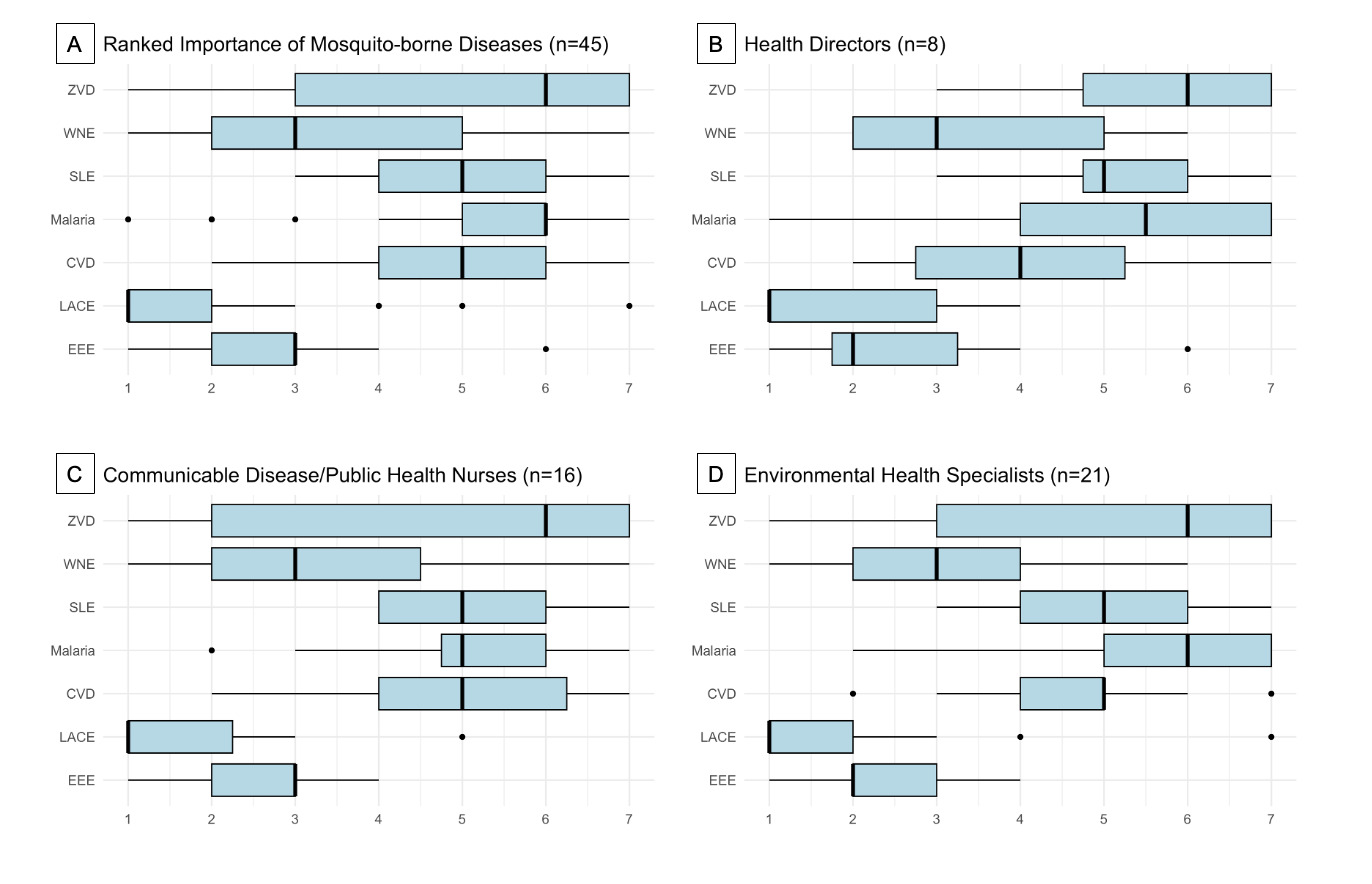
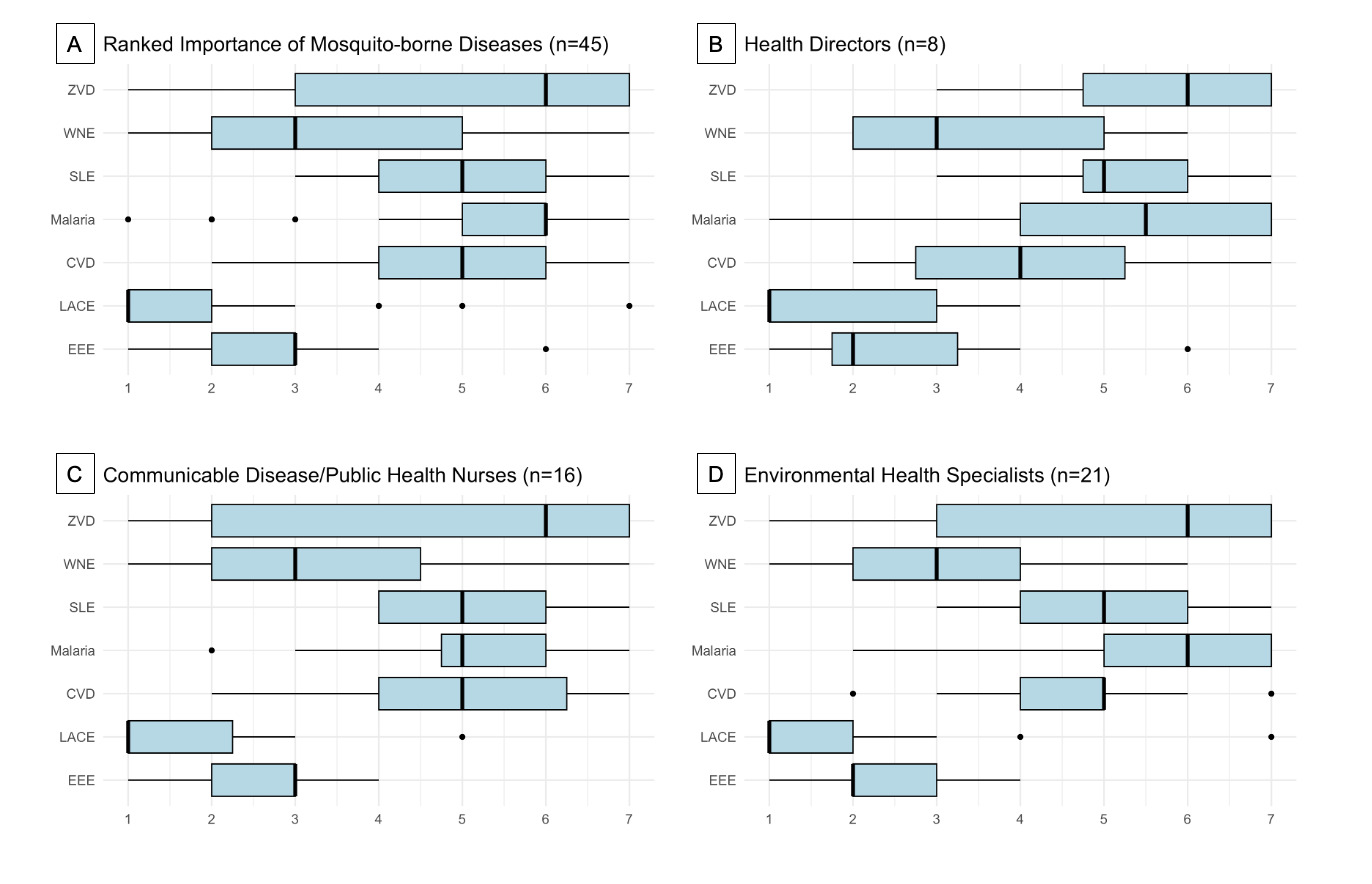
Respondents ranked selected mosquito-borne diseases in order of importance (public health relevance) for their respective counties (Figure 2). The choices included the following endemic and travel-related mosquito-borne diseases: eastern equine encephalitis, chikungunya virus disease, La Crosse encephalitis, malaria, St. Louis encephalitis, West Nile encephalitis, and Zika virus disease; the default order choice in the survey was alphabetical. La Crosse encephalitis (LACE) was overall ranked as the most important mosquito-borne disease of public health relevance (Wilcoxon signed-rank tests with Bonferroni correction, P < .01). Other endemic arboviral diseases, EEE and West Nile encephalitis, were ranked second and third, respectively, in terms of public health importance. This trend was consistent when evaluated by professional job category; however, pairwise comparisons were not significantly different for LACE and EEE (P > .05) for health directors, CDNs, or EHS. Pairwise comparisons suggest that LACE was ranked higher than the remaining mosquito-borne diseases by CDNs and EHS personnel; the small sample size for health directors limits statistical inference.
Mosquito Surveillance and Control Capacity
Health department directors and EHS personnel reported their respective health department’s mosquito surveillance and control capacities (Table 1) in the context of a comprehensive evidence-based mosquito control program using standards developed by NACCHO and the CDC. The 5 core capacities developed by NACCHO include 1) routine surveillance, standardized trapping, and identifications; 2) treatment decisions using surveillance data; 3) larviciding, adulticiding, or both; 4) routine vector control; and 5) pesticide resistance testing. The percentage of health departments reporting existing capacity for the individual core standards ranged from 10% to 40%, with one county reporting existing capacity for all 5 core standards. The most common standard (i.e., treatment decisions using surveillance data) existed in 40% of the counties; 20% of counties reported routine surveillance or routine vector control. A single county reported pesticide resistance testing. Health departments reporting existing capacity for the individual supplemental standards ranged from 10% to 50%. The most common supplemental capacity (community outreach and education activities) was reported in 50% of the counties. A single health director reported “in house” personnel with a pesticide applicator’s license. One of 10 counties reported existing capacity for all 5 supplemental standards; this county had all 5 core capacities as well.
Knowledge of Risk Factors for La Crosse Encephalitis
To evaluate the knowledge of health department personnel regarding risk factors increasing transmission risk, environmental health specialists (EHS) and communicable disease nurses (CDN) were surveyed using questions designed to assess their understanding of environmental and behavioral risk factors associated with mosquito-borne diseases in general, and La Crosse encephalitis specifically.
CDN and EHS personnel were surveyed to assess their knowledge of potential environmental risk factors associated with La Crosse encephalitis (LACE) (Table 2). A large majority (≥ 75%) of CDNs correctly identified 5 out of 6 environmental risk factors known to specifically increase the risk of LACE. However, 56.2% recognized the absence of air conditioning at a residence as a risk factor. All CDN respondents (n = 16) misidentified a “pond near residence” as a LACE risk factor, and 68.75% misidentified “creek near residence” as a risk factor. In contrast, a large majority (≥ 75%) of EHS personnel correctly identified 3 of the 6 environmental risk factors known to specifically increase the risk of LACE. However, fewer than 75% of EHS personnel correctly identified “empty planters and flowerpots with standing water,” “lack of air conditioning,” and “used car tires at the residence” as LACE risk factors.
Notably, EHS personnel were more accurate than CDN personnel in identifying that the presence of a creek (81.82%) or pond (63.6%) near a residence are not LACE risk factors (Z-statistic = 3.15 (creek), 4.1 (pond), P < .01). The proportion of EHS and CDN staff who misidentified standing water in a ditch near the home as a risk factor was not significantly different.
CDN and EHS personnel were similarly surveyed to assess their knowledge of potential behavioral risk factors associated with LACE (Table 3). A large majority (≥ 75%) of CDNs correctly identified 4 out of 5 behavioral risk factors known to specifically increase the risk of LACE. Approximately two thirds of CDNs recognized that “having a sibling with LACE 3 years prior, and they live at the same house” was a risk factor. All CDN respondents (n = 16) correctly identified the “lack of repellent use” as a risk factor that increases risk for LACE. Additionally, 66.7% of CDNs recognized that loose-fitting clothing is actually a protective factor. A large majority (≥ 75%) of EHS personnel correctly identified 2 out of 5 behavioral risk factors known to specifically increase LACE risk, and 91.9% of EHS personnel recognized that loose-fitting clothing is actually a protective factor. Importantly, only 27.3% of EHS personnel recognized that “having a sibling with LACE 3 years prior, and they live at the same house” is a known risk factor. The proportion of EHS personnel recognizing this spatiotemporal risk factor was significantly lower than the CDN staff (66.7%) (Fisher’s Exact Test, P = .0184). Similarly, EHS personnel were less likely than CDNs to identify “spending time outside in the yard after school” as a risk factor (50% versus 86.7%), and this difference was statistically different (Fisher’s Exact Test, P = .0353).
External Resources
Only 12.5% of responding health directors reported that they have received funding directly from the State of North Carolina for Mosquito and Tick Suppression via the AA908 (Agreement Addendum) mechanism during the past decade. None of the responding health directors reported receiving federal support (e.g., grants or project funds) for mosquito control or vector surveillance during the past decade. Half of the responding health directors reported that they would support the receipt of state or federal funding to increase mosquito-borne disease response capacity within their health department; the remaining 50% reported they were unsure. Only one health director had knowledge of the statewide “Mosquito Abatement Contract” managed by the North Carolina Department of Public Safety; this contract period expired in August 2024.
In the “event of serious mosquito-borne disease issues (e.g., a fatal case or disease cluster)” health directors (n = 8) identified the most common external resources they would consider enlisting to support a public health response, which included the North Carolina Department of Health and Human Services Communicable Disease Branch (100%), university (e.g., North Carolina State University, Western Carolina University) experts (87.5%), Public Health Preparedness and Response Teams (62.5%), and the CDC (62.5%). Interestingly, only two health directors reported private pest control applicators (local/regional businesses) as external resources they would enlist.
Vector-Borne Disease Prevention as a Role of the Environmental Health Specialist
EHS respondents (n = 23) strongly (73.9%) disagreed with the statement: “vector-borne disease prevention is not a professional role of the environmental health specialist.” One individual (4.4%) agreed with this statement, and the remainder (21.7%) were neutral in their response. The same proportion (73.9%) disagreed with the statement that “although vector-borne disease prevention and control is a professional role of the environmental health specialist, I personally have no interest in the role.” However, 43.5% (n = 23) of the EHS respondents agreed with the statement that “we are too busy with other responsibilities to provide this service.” Most EHS personnel (69.6%) stated that they were personally interested in providing vector-borne disease prevention and control as a service. However, 43.5% of EHS respondents reported that they “do not feel qualified to provide this service.”
Prevention and Response Barriers
Health directors overwhelmingly (85.7%) reported that the biggest barrier to establishing mosquito-borne disease prevention and response capacity within their health department was personnel/staff capacity. Thematic analyses of open-ended responses identified the need for increased and sustained funding for capacity-building efforts across WNC.
LACE Case Identification
A case study (Appendix A) was reviewed by CDNs (n = 14) to assess abilities to interpret clinical and laboratory criteria that meet the current (2015) case definition for neuroinvasive California serogroup virus disease; most neuroinvasive California serogroup virus disease in WNC children is caused by LACV.25 The case study provided both clinical and laboratory evidence supporting disease caused by a member of the California serogroup (CSG) of viruses, which in WNC would most likely be LACV, rarely could be Jamestown Canyon virus, and is highly unlikely, in the absence of travel, to be California encephalitis virus.10,26 The majority (64.3%) of CDN respondents selected that the “child’s disease was most likely caused by California encephalitis virus,” 21.4% reported that the disease was “…not likely caused by an arbovirus,” while 14.3% correctly reported that the disease “…was most likely caused by La Crosse virus.” A follow up question asked if the case met “the laboratory criteria for the case definition for an arboviral disease.” Of the 15 CDN respondents, 53.3% stated “Yes,” while the remainder stated that they were unsure.
Training and Education
Health directors unanimously (100%, n = 8) reported that if funding was available to cover all associated expenses, they would participate in a “regional Incident Command System tabletop exercise for a local mosquito-borne disease outbreak.” Multi-day trainings, whether held in-state (37.5% supported) or out-of-state (25% supported), were generally not well received. CDN respondents largely supported 1-day regional continuing education workshops on vector-borne disease epidemiology and laboratory testing (81.3%), and 68.8% were likely to attend an Incident Command System tabletop exercise for a local mosquito-borne disease outbreak.
Most EHS respondents (87.5%) reported completing a college-level epidemiology course, while 12.5% of CDN respondents indicated they had done the same. Fewer EHS respondents reported taking a college-level medical entomology course (43.8%) or vector-borne disease course (37.5%). A limited number of respondents (< 33%) reported taking continuing education credits relating to vector-borne infectious disease or vector control.
Thematic analyses of open-ended responses from EHS personnel revealed a clear need for enhanced training and education on vector-borne diseases, particularly in areas like mosquito identification and prevention. Respondents also stressed the importance of adequate time, staffing, and financial support to develop or expand effective vector control programs, as small county resources are often stretched thin. Thematic analyses of open-ended responses from CDNs similarly indicated a strong desire for increased education and training, particularly in areas like lab interpretation, arbovirus trends, and vector-borne disease prevention.
Discussion
This assessment clearly demonstrates that, despite recognizing La Crosse encephalitis (LACE) as the most important mosquito-borne disease in WNC, local health department personnel encounter challenges in preparedness, interpretation of diagnostic laboratory results, and resource availability. These findings underscore an urgent need for targeted investments in workforce training, surveillance infrastructure, and sustainable funding to support effective vector-borne disease response broadly. Surveillance and control capacities were notably limited across the region, and only one county met all 5 NACCHO-defined core and supplemental standards. Key capacities such as routine entomologic surveillance were reported by only a few health departments (Table 1). Knowledge of LACE-specific risk factors also varied, although CDN personnel generally demonstrated a stronger understanding of environmental and behavioral risk factors than EHS personnel; however, both groups exhibited gaps in identifying key behavioral risk factors and protective environmental factors. Most CDN respondents demonstrated difficulty accurately identifying La Crosse virus (LACV) as the likely cause of a case study (Appendix A), while 14.3% selected the correct agent despite appropriate clinical and laboratory evidence. The most common response (“the child’s disease was most likely caused by California encephalitis virus”) may demonstrate uncertainty about the members of the California serogroup of viruses. Additionally, 53.3% of CDN respondents recognized that the case met the laboratory criteria for an arboviral disease, indicating potential gaps in diagnostic interpretation.
Our assessment also revealed meaningful barriers to improving local vector-borne disease response. Most health directors cited limited personnel capacity as the primary constraint, emphasizing the need for sustained funding to support capacity building. State and federal financial support was rare, and health departments reported limited awareness of existing external resources. The one county that had all 5 core and supplemental mosquito control and surveillance capabilities was also the only county reporting active state funding (AA908 contracts). While most EHS respondents recognized vector-borne disease prevention as a professional responsibility and expressed interest in participating, many felt unqualified or too overburdened to provide such services. Overall, the health department personnel expressed strong interest in increased training opportunities. Respondents favored short (1-day) regional offerings focused on practical skills such as mosquito identification, laboratory result interpretation, and disease trends. These findings highlight a regional need for increased investment in personnel, training, and infrastructure to strengthen preparedness and response capacity for LACV and other mosquito-borne pathogens.
Limitations
This study was limited by a small sample size (N = 47), a moderate response rate (36.7%), and reliance on self-reported data. Variation in job roles may have affected how questions were interpreted. However, participation from all 10 WNC counties with the highest incidence of LACE disease and statistically significant findings for key risk factors and roles support the study’s robustness. Also, the low number of health directors (n = 8) limits the robustness of the study statistically, and thus their role-specific responses should be contextualized as such.
The primary goal of this study was to evaluate LACV prevention, detection, and response capacity in North Carolina county health departments. Other public health agencies, namely the Eastern Band of Cherokee Indians Public Health & Human Services agency and the North Carolina Public Health Preparedness and Response branch (North Carolina Department of Health and Human Services) were not included in this survey. Future efforts to develop a regional approach to LACV prevention, detection, and response should include these important partners. The survey was developed using CDC and NACCHO vector control capacity guidance with additional questions developed by state and regional vector-borne disease subject matter experts. The instrument was designed as an applied public health capacity assessment rather than a psychometric scale. As such, formal scale validation methods were not conducted. The survey included both role-specific response items and structural indicators to evaluate operational realities across health departments.
This study was conducted in 2024, nearly a year after the World Health Organization announced the end of the COVID-19 epidemic as a public health emergency of international concern.27 The impacts of COVID-19 on the public and environmental health workforce clearly limited vector-borne disease preparedness and response, as many personnel had to shift priorities to support the pandemic response. These shifts contributed to underdiagnosis, underreporting, and reduced data availability in 2020 and 2021, which likely continues to affect funding, staffing, and institutional prioritization of vector-borne diseases in local health departments.28 The results of our study should thus be contextualized with the potential lingering impacts of COVID-19 in addition to other shifting public health priorities and chronic public health workforce challenges.3 Furthermore, the survey was conducted in February and March of 2024, which is outside the typical time when mosquito activity is common in WNC. Finally, while the assessment presented here emphasizes LACV, the survey instrument assessed vector-borne disease capacity more broadly, and respondents may have interpreted some items in the context of general mosquito-borne disease preparedness rather than LACV specifically.
Conclusion
Going forward, the information gained from our survey can be used to prioritize training interventions to improve LACE case prevention, detection, and response capacity for WNC. Training sessions, including the use of case studies, to help improve CDN knowledge and application of case definitions for La Crosse encephalitis (and other vector-borne diseases) should be developed. Given that LACE is clearly recognized as a regional public health issue and that individual counties report very few cases each year, it may be more effective to use a regional approach to training and vector control that combines personnel, equipment, and other resources for case investigations and response. By leveraging coordinated approaches like region-specific training opportunities (e.g., tabletop exercises simulating local mosquito-borne disease outbreaks; mosquito surveillance and control workshops; virtual competency-based trainings for arboviral laboratory test interpretation), WNC can more effectively build the workforce capacity, surveillance systems, and resource-sharing networks needed to reduce the burden of LACE and other vector-borne diseases.
Acknowledgments
The authors thank the dedicated public health teams in WNC that participated in this study. This study was supported, in part, by the North Carolina Department of Health and Human Services, Communicable Disease Branch, as an Epidemiology and Laboratory Capacity for Prevention and Control of Emerging Infectious Diseases (NU50CK000530) subcontract (Centers for Disease Control and Prevention).
Disclosure of Interests
The authors have no relevant conflicts of interest relating to this study.
Correspondence
Address correspondence to Dr. Brian Byrd, Western Carolina University, 3971 Little Savannah Road, Cullowhee, NC 28723 (bdbyrd@wcu.edu).