Introduction
Rural hospitals have long served as anchors of health care access, economic stability, and emergency preparedness across North Carolina. Yet the past decades have brought greater economic risk to many rural hospitals. Financial distress, workforce shortages, and rising uncompensated care costs have left rural facilities operating on the brink. As federal policymakers advance sweeping changes to Medicaid financing and introduce new rural health programs, North Carolina’s rural hospitals face both heightened risk and new opportunity. Whether these forces ultimately stabilize or weaken rural care delivery will depend on how state leaders, hospital administrators, and communities navigate the years ahead.
The Rural Hospitals of North Carolina
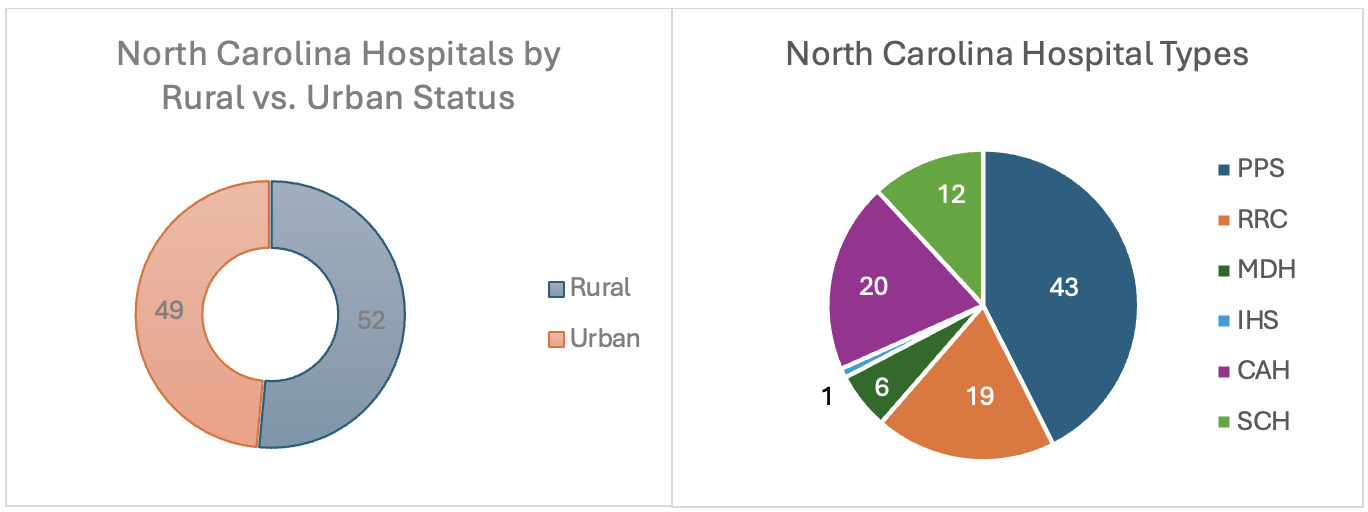
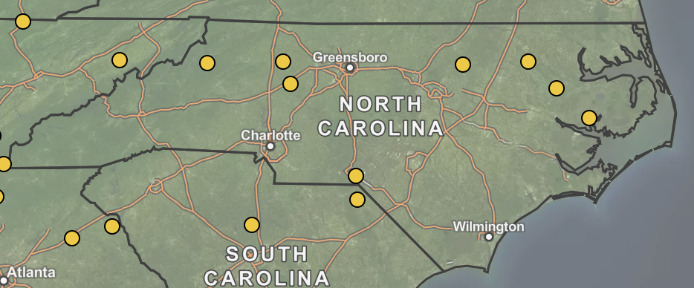
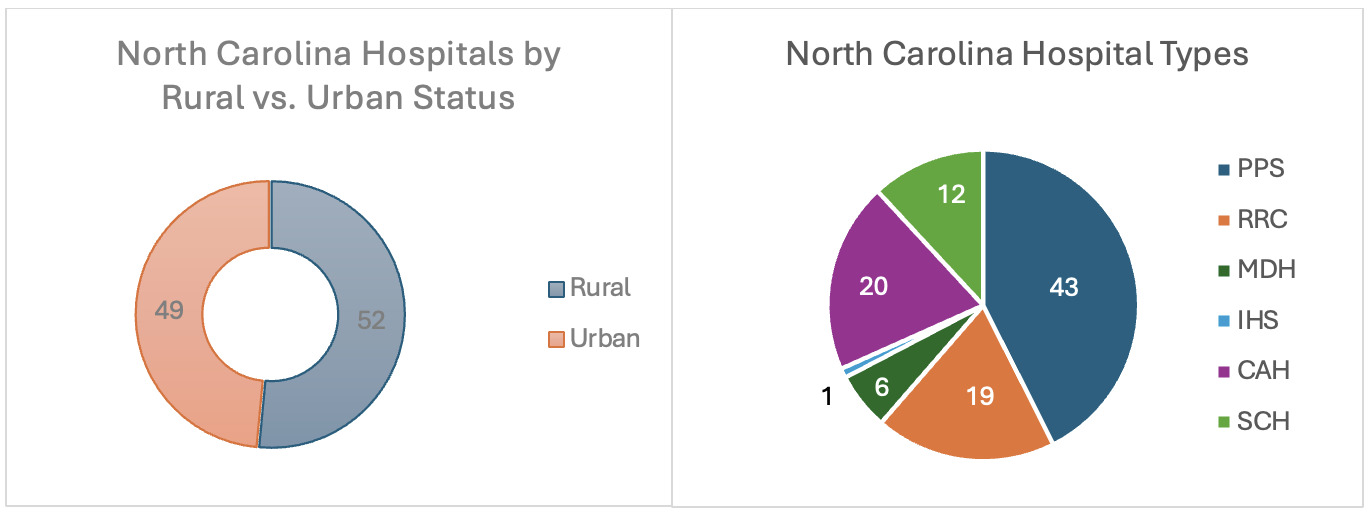
North Carolina’s rural hospital landscape includes small rural prospective payment (PPS) hospitals, critical access hospitals (CAHs), sole community Hospitals (SCH), Medicare dependent hospitals (MDH), Rural Referral Centers (RRC), and an Indian Health Service (IHS) hospital (Figure 1).1 Ownership of these facilities ranges from government, non-profit, and for-profit, and comprises a mix of independent community hospitals, rural facilities embedded within larger regional systems, and private-equity or investor-owned models.
Rural hospitals tend to serve counties with higher poverty rates, older populations, and fewer clinicians per capita than urban areas. Nationally, over 40% of rural hospitals operate at a loss, and 417 facilities are vulnerable to closure.2 The UNC Cecil G. Sheps Center for Health Services Research has documented the financial vulnerability of North Carolina’s rural hospitals, including hospital closures, workforce losses following closures, and heightened vulnerability of hospitals with large Medicaid patient populations.3
Current Status: Financial Distress and Service Line Contraction
The pressures facing rural hospitals are multifaceted, including a combination of declining inpatient volumes, high fixed operating costs spread over low patient volumes, rising labor and supply expenses, heavy dependence on public payers like Medicare and Medicaid, and mounting levels of uncompensated care that leave many facilities operating on the edge of financial viability. Further, rural hospitals face numerous structural challenges like aging infrastructure, outdated electronic health record (EHR) systems, workforce shortages across clinical and operational roles, and patient populations with higher rates of chronic disease and socioeconomic disadvantage.
Since 2010, 207 rural hospitals have closed or converted, including loss of inpatient capacity through transition to the Rural Emergency Hospital (REH) model.4 Closure of specific high-cost services occurs when hospitals are under financial pressure. Service line reductions in rural areas are widespread, with more than 300 hospitals having eliminated obstetrics, more than 300 having eliminated general surgery, and more than 450 having eliminated chemotherapy services nationwide since 2010.2
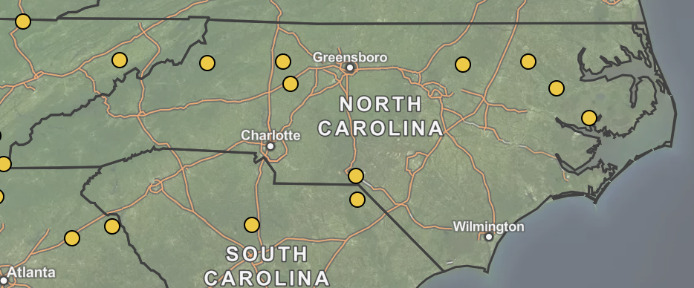
In North Carolina, multiple rural hospitals are considered to be at the highest risk of financial distress as of 2023.5 As of 2010, eight rural hospitals in North Carolina have closed or converted status, with several more having consolidated or eliminated services like obstetrical care.2,4
Upcoming Risks: House Resolution 1 Medicaid Changes
Medicaid plays an outsized role in rural hospital finances. Nationally, Medicaid reimbursements account for nearly 10% of net revenue, or approximately $3.9 million annually for the typical rural hospital.6 To date, rural hospitals in Medicaid expansion states have a substantially lower likelihood of closure and better financial performance than those in non-expansion states.7 In North Carolina, where rural poverty rates exceed state averages, Medicaid is a critical stabilizing force with rural residents enrolled at significantly higher rates than urban residents (32.1% versus 25.7% in 2025).8
The most significant near-term threat to rural hospitals is the Medicaid restructuring embedded in Public Law 119-1, commonly known as House Resolution 1 (HR1).9 HR1 cuts federal Medicaid spending in rural areas by an estimated $137 billion over ten years.9 These cuts are expected to disproportionately affect rural communities, where Medicaid enrollment is high and hospitals rely heavily on Medicaid revenue to maintain essential services. As a result, North Carolina rural hospitals may face a number of related impacts, including increases in uncompensated care due to coverage losses, new administrative burdens due to rural enrollment barriers, and reduced provider reimbursement due to state cuts to optional benefits or reduced payments. These impacts may push rural hospitals already operating at a loss towards further destabilization and accelerated closure risk.
Upcoming Opportunities: Federal Investments and Policy Momentum
Federal policymakers have signaled growing concern about rural hospital stability. Several new programs and legislative proposals offer meaningful opportunities for North Carolina’s rural hospitals.
The Rural Health Transformation Program (RHTP)
The most consequential new investment is the $50 billion RHTP, established under HR1 and administered by the Centers for Medicare & Medicaid Services (CMS). RHTP will distribute $10 billion annually from 2026 through 2030 to all 50 states.10 In 2026, North Carolina received an award totaling $213 million, with additional years anticipated. This investment is expected to result in a $305 million gain in North Carolina state gross domestic product, resulting in 2600 new jobs (1200 health-related and 1400 indirect).11
RHTP state plans to address rural hospitals focus heavily on structural resilience, regional cooperation, and financial modernization to keep struggling facilities open and stabilize operations in order to engage in transformation. Several states’ RHTP initiatives emphasize development of rural hospital networks with shared service agreements across independent rural facilities, pooling administrative, reporting, and back-office operations to create economies of scale. Others look to regionalization and hub-and-spoke models that partner local community rural hospitals together, and/or with larger regional facilities, to coordinate specialty care and emergency routing. Some approaches focus on alternative payment models transitioning from pure volume-based fee-for-service (which is financially challenging for rural hospitals) to value-based purchasing, flexible global budgets, and revenue diversification models. Still, other states are looking towards service redesign, shifting low-acuity or specialized services to lower-cost settings, mobile units, or community-based care points.
North Carolina’s RHTP places rural hospitals at the center of its redesign strategy, focusing on stabilizing facilities and strengthening financial sustainability through hospital feasibility and redesign projects, and integrating them into new community-rooted care networks. The state’s implementation is well underway through 6 integrated initiatives to address workforce, access, technology, behavioral health, chronic disease, and payment models.12 Focused on 55 rural hospitals statewide and 5 identified as at immediate risk, the program’s early milestones reflect a deliberate effort to support hospitals through value-based payment (VBP) transitions, digital modernization, and coordinated care models. Specifically, the state is focused on establishing capabilities for rural primary care practices to participate in advanced VBP models and is laying the groundwork for rural hospital participation in VBP arrangements as a path to financial sustainability. This work builds on long-standing investments in rural hospitals through the Medicare Rural Hospital Flexiblity and Small Rural Hospital Improvement Programs, which have provided critical technical assistance and support for rural hospital financial sustainability and have preserved access since, following widespread rural hospital closures in the 1980s and 1990s.
Rural Emergency Hospital (REH) Pathway
Established by Congress in 2021, the REH designation officially began under Medicare in 2023. To date, 53 rural hospitals have converted to REH status.13 The REH model allows struggling facilities to close inpatient services and pivot exclusively to emergency and outpatient services. In exchange, they receive enhanced Medicare reimbursement rates and a fixed monthly federal subsidy. Some states are leveraging their RHTP funding to support, incentivize, and manage REH conversions.
The REH model offers a lifeline for hospitals unable to sustain inpatient services. However, community engagement is essential to ensure that REH conversions align with local needs. As facilities consider conversion, states may choose to require community input into closure or conversion decisions, ongoing community consultation on REH operations, and integration of REH planning into triennial community health needs assessments, including coordination with EMS and referral hospitals for inpatient services.14 These requirements can help ensure that REH transitions strengthen, rather than weaken, local rural care networks.
Congressional Attention and New Annual Appropriations
Congress has increasingly recognized the fragility of rural health infrastructure. In addition to creation of the RHTP, federal appropriations proposals for fiscal years 2026 and 2027 include new rural hospital stabilization initiatives. These programs reflect bipartisan acknowledgment that rural hospitals are essential to community vitality, emergency preparedness, and economic stability. Even modest investments signal a renewed commitment from Congress to sustaining rural health infrastructure.
Among these investments are technical assistance programs like the Rural Hospital Stabilization Program, funded by the Health Resources and Services Administration’s (HRSA) Federal Office of Rural Health Policy, to offer free technical assistance to hospitals on transformation strategies.15 The REH-Technical Assistance Center offers financial modeling, feasibility assessments, strategic planning for rural hospitals considering REH conversion.16 Through the US Department of Agriculture’s Rural Hospital Technical Assistance program, rural hospitals can receive assistance to enhance hospital systems for improved efficiency and financial performance, bolster quality of care, and support the community.17 Reinforcing awareness of these free federal assistance programs can help rural hospitals make informed, cost-effective decisions.
Balancing Risks and Opportunities
North Carolina’s rural hospitals are navigating a moment of profound uncertainty. The central question for North Carolina, and the rest of rural America, is whether RHTP and other federal investments can offset the financial losses anticipated under HR1. Unfortunately, at this point, the data are insufficient to determine whether the program can achieve its intended goal. Rural hospitals serve as the backbone of local health care access. Current evidence indicates that states are only directly investing a small fraction of the funds to stabilize rural hospitals. True transformation in rural health care, particularly in shifting away from volume-based reimbursement towards value-based payment models, requires time, sustained stakeholder engagement, and significant resource investment. Given the expedited timelines of RHTP implementation, many states appear to have concentrated on more attainable, low-complexity activities rather than the deeper, more challenging work required to fundamentally redesign rural care delivery toward outcomes-based models.
While RHTP represents an unprecedented investment in rural health care, analysis shows the funds only cover about 37% of projected losses, further threatening rural hospital viability.9 Further, if all $50 billion of RHTP went directly to rural hospitals, the program would not offset the expected federal Medicaid losses.18 For rural America, the implications are clear. RHTP funding will help, but it is not a substitute for adequate reimbursement for rural programs from Medicare, Medicaid, and private insurance.
North Carolina’s early RHTP award is encouraging, but the state must continue to leverage federal programs aggressively while advocating for Medicaid policies that protect rural hospitals. The path forward requires coordinated action among state leaders, rural hospital administrators, the federal government, and community stakeholders to determine whether these transitions strengthen or fragment rural health systems. North Carolina has an opportunity to lead, but without careful planning and strong policy alignment, the state’s rural hospitals may find themselves navigating federal funding changes without the lifelines they need.
Carrie Cochran-McClain, DrPH, MPA Chief Policy Officer, National Rural Health Association, Washington, D.C. www.ruralhealth.us/advocacy
Acknowledgments
The author has no conflicts of interest to disclose.
Correspondence
Address correspondence to Carrie Cochran-McClain, National Rural Health Association, 50 F Street NW, Suite 520, Washington, DC 20001 (ccochran@ruralhealth.us).