Introduction
Like many rural Americans, I didn’t think a lot about health care access until I needed it. The night I drove through the twisty, windy roads that make up our mountain community, with my mom in pain next to me, I wasn’t thinking about why we didn’t have a hospital in my town. I just knew I needed to get my mom help as fast as I could. My mom had been complaining about pain in her abdomen (what would later be diagnosed as a gall bladder infection) for about a week. One evening, while I was doing homework at the dinner table, she said we needed to leave for the emergency room (ER). The only problem: the ER that took our insurance was about 50 minutes away, most of it through dark, country roads. We got in the car and made the trip.
As a teenager, there was much I did not understand about the broader health care system, but I did see one thing clearly: in our community, getting to the care we needed always took longer. My story is not unique, and in so many ways we were lucky. We had good health insurance through my dad’s job as a public school teacher, we were within an hour’s drive of an ER, and we had a reliable car to get there. The fact that this story is not unique is part of the problem—access to high-quality care in our state’s rural areas is limited, making it harder and harder for patients to get help when and where they need it.
North Carolina’s Rural Health Transformation Program (RHTP) investments are designed to change the conditions behind stories like mine. By strengthening coordination across medical, behavioral, and social supports; expanding access to telehealth; and investing in “grow-your-own” workforce strategies that help rural communities train and retain their own clinicians, the program aims to reduce the extent to which geography determines if someone can get care. These investments are especially important as many rural communities face rapidly aging populations, increasing the need for accessible primary care, chronic disease management, and support services close to home.1
The North Carolina RHTP will not eliminate every challenge rural communities face—long travel distances, workforce shortages, and economic pressures will persist—but it can meaningfully shift the systems that make care so hard to reach. Its investments create more connected, accessible, and sustainable pathways to care, and give rural communities tools they have never had before to shape the future of their own health.
What Is Rural Health Transformation and What Is the Vision?
The federal RHTP was authorized under Public Law 119-21, commonly known as House Resolution 1 (H.R. 1) by the 119th Congress, to help states redesign rural health care delivery in ways that expand access, improve quality, and strengthen outcomes. Nationally, the program is guided by five key goals: making rural America healthy again, ensuring sustainable access to care, strengthening the rural health workforce, advancing innovative care models, and modernizing rural health through technology. Together, these goals reflect a broad federal commitment to addressing longstanding gaps in rural health systems. Under this framework, the U.S. Centers for Medicare & Medicaid Services (CMS) established a $50 billion fund, with each state—including North Carolina—equivalent to an average of approximately $1 billion per state.2
Rural Health Transformation in North Carolina
In North Carolina, this work builds on a long history of cross-sector partnership. More than 400 organizations and individuals across the state collaborated to shape North Carolina’s application, which resulted in an award from CMS for over $213 million in federal funding for budget period 1, granted in December 2025. The strategy reflects decades of collaboration across Medicaid, public health, hospital systems, behavioral health providers, Tribal partners, and community-based organizations (CBOs).3
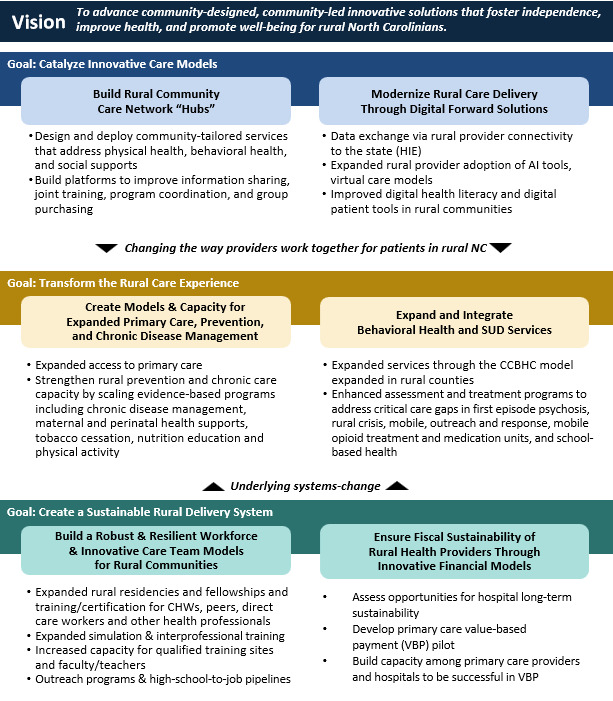
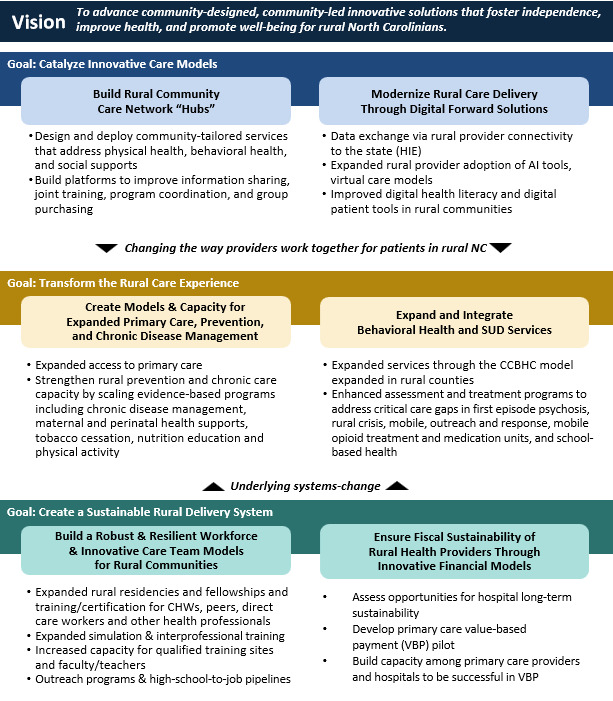
North Carolina’s vision for Rural Health Transformation is to advance community-designed, community-led innovative solutions that foster independence, improve health, and promote well-being for rural North Carolinians. Anchored in this vision, North Carolina seeks to achieve three goals for rural communities:
-
Catalyze innovative care models, changing the way providers work together to care for patients in rural NC;
-
Transform the rural care experience, building community-based clinical, behavioral, and social supports close to home; and
-
Create a sustainable rural delivery system through underlying systems change in rural workforce pipelines and care team models, and rural provider financial models.
By 2031, North Carolina’s RHTP aims to achieve significant, measurable improvements in each rural community we serve in line with CMS’s overarching Rural Health Transformation goals and requirements. These goals recognize that transformation must be meaningful not only at the state level but in each region, county, and community where residents experience the realities of access barriers, provider shortages, and fragmented systems.
To operationalize this vision, North Carolina identified 6 overarching program initiatives that together drive Rural Health Transformation across the state. These initiatives align with the program’s three major goals and outline the specific strategies needed to achieve them. They include building coordinated rural community care networks, modernizing care delivery through digital-forward solutions, expanding access to primary and preventive care, strengthening behavioral health and substance use disorder (SUD) services, developing a resilient rural workforce, and establishing innovative financial models to support long-term sustainability. Figure 1 summarizes these initiatives and shows how they collectively advance North Carolina’s commitment to community-led, regionally tailored rural health transformation.
The North Carolina Challenge and Opportunity
From the Outer Banks to the Blue Ridge Mountains, one-third of North Carolinians live in rural areas, reflecting the breadth of the state’s people, culture, geography, and health systems. Rural communities face widening gaps in access, quality, and outcomes that demand bold, coordinated action. With more than 3 million rural residents, the rural population in North Carolina is second in size only to Texas, larger than the rural populations of 20 other states combined, and represents more than 5% of the entire US rural population.4,5 North Carolina’s rural communities are also highly varied in their assets, needs, and challenges. Strategies that recognize these differences, and are shaped by local input, are essential to building solutions that communities will trust and use. The North Carolina RHTP was designed with this in mind: a statewide framework that supports regional flexibility, paired with community led governance that ensures decisions reflect local realities.
Rural communities face interconnected challenges that limit access to coordinated, high-quality care. Medical, behavioral, and social services often operate in silos with weak referral pathways. Madison County residents, for example, travel more than 30 miles to Asheville for behavioral health and specialty care, gaps further widened by the impacts of Hurricane Helene in September 2024. North Carolina’s answer is to knit these fragmented services into a connected system of care: regionally governed, cross-sector networks that align and embed standardized referral pathways so medical, behavioral, and social supports operate together.
Chronic disease and behavioral health needs are also more acute in rural North Carolina, where diabetes prevalence is 46% higher and cardiovascular disease is 53% higher than in urban areas,4 and mental health shortages affect 97 of 100 counties6—with American Indian communities, especially adolescents, experiencing disproportionate crises.7 In Robeson County, home to many Lumbee Tribal members, diabetes prevalence is among the state’s highest at 15.2%, compared with 10.1% in urban counties.8 The North Carolina RHTP translates statewide priorities into locally tailored strategies, expanding the North Carolina Minority Diabetes Prevention Program, a 12-month community-centered initiative that can lower participants’ risk of developing type 2 diabetes by up to 58%.9
Workforce shortages compound these gaps: 24 rural counties lack sufficient primary care providers, and Bertie County has just one primary care physician per 3500 residents—far below the recommended ratio of 1 per 1500.4 The North Carolina RHTP responds with “grow your own” strategies rooted in each region’s assets, expanding rural residencies and fellowships; building pipelines for community health workers, peer support specialists, and direct care workers; and partnering with AHECs, community colleges, and UNC System institutions to create new training sites and interprofessional learning opportunities.
Financial instability, digital barriers, and access to prevention services further strain rural care. Since 2006, 12 rural hospitals have closed or converted to limited-service models,10 including Martin General in 2023, which now sends roughly 22,000 residents more than 30 miles for emergency and inpatient care, and five more remain at immediate risk.11 Limited broadband and low digital literacy leave communities like mountainous Swain County without reliable navigation support, while preventive care lags, with only 62% of Sampson County children receiving recommended well-child visits.12 Across each of these gaps, the North Carolina RHTP builds coordinated care networks that layer onto, rather than duplicate, existing local infrastructure: stabilizing hospitals through innovative payment models and feasibility assessments, funding an NCDIT–NC 211 partnership for multilingual digital health literacy support, and linking pediatric providers, schools, behavioral health clinicians, Tribal partners, and community-based organizations to deliver timely screenings and continuous care.
NC ROOTS Hub Model
A key component of North Carolina’s RHTP is the North Carolina ROOTS (Rural Organizations Orchestrating Transformation for Sustainability) Hub Model. The ROOTS Hub Model is foundational for a future where rural health care is no longer a fragmented network of providers working independently, but a true system of care that coordinates to deliver community-driven solutions.
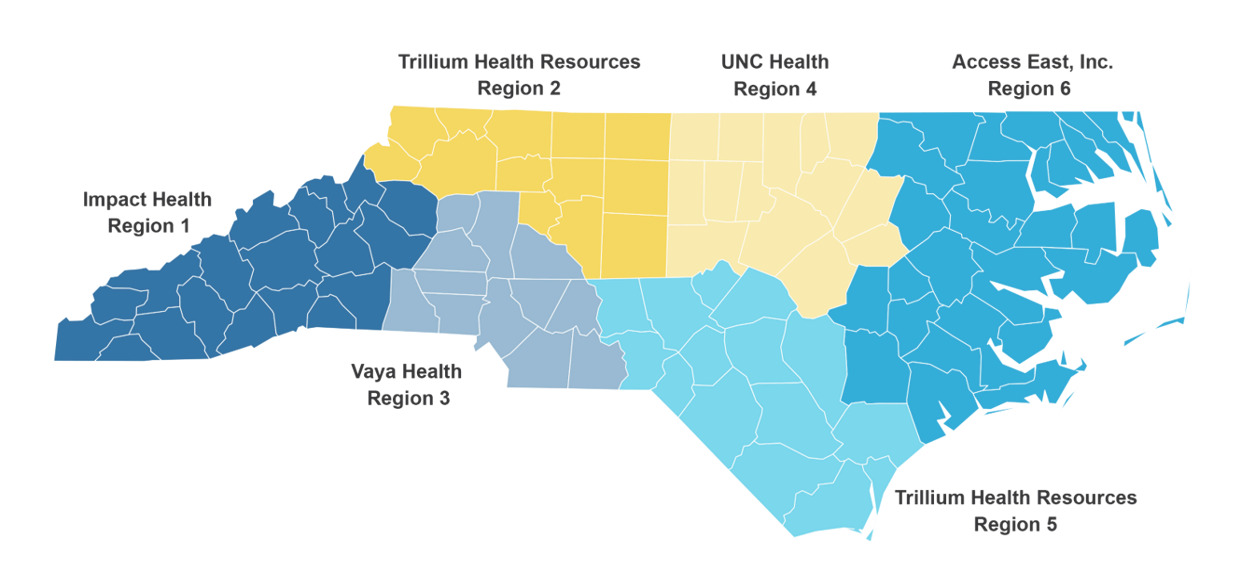
The ROOTS Hubs are six regionally governed cross-sector networks responsible for coordinating medical, behavioral health, and social supports across rural communities. They function as a foundational implementation arm of the North Carolina RHTP, translating statewide priorities into locally tailored strategies that reflect each region’s needs, assets, and resources. While the state provides the scaffolding needed for transformation, including infrastructure investments, digital modernization, technical assistance, statewide data interoperability, and multi-payer alignment, ROOTS Hubs supply the localized governance, coordinated care networks, and community-rooted decision making that ultimately make rural transformation durable and sustainable. The ROOTS Hubs also coordinate and layer on existing care and networks in North Carolina, supporting, not duplicating, the role of key organizations and people advancing health care in rural areas.
This shared structure reflects the understanding that meaningful rural transformation requires both statewide consistency and regional flexibility. The North Carolina RHTP sets the vision and provides the tools, while the ROOTS Hubs bring that vision into practice by convening partners, setting priorities, designing action plans, and ensuring that medical, behavioral health, and social supports work together in ways that strengthen health outcomes and economic opportunity across rural North Carolina.
The regional model builds on North Carolina’s strong history of regional delivery infrastructure, including the Healthy Opportunities Pilots (HOP), which operates in three predominantly rural regions of North Carolina, and offers a strong model for locally governed transformation. Through a network lead organization that develops and supports a coordinated network of community-based organizations, HOP has demonstrated how regional infrastructure can facilitate cross-sector collaboration, economic development, service delivery, and accountability while remaining responsive to community needs.13,14 North Carolina’s regional RHTP approach also mirrors growing federal recognition of community care hubs (CCH), including proposed Medicare policies creating new reimbursement pathways for CCHs delivering health coaching services.15
Together, these elements form the foundation of the ROOTS Hub Model, but the heart of the model lies in how each Hub is governed and how care is coordinated across partners. After establishing regional infrastructure and aligning statewide tools, ROOTS Hubs must put this structure into practice through community-led governance and networks that integrate medical, behavioral health, and social supports. These governance and coordination functions are what ultimately turn statewide strategy into meaningful change for rural communities.
Local Governance and Coordinated Care
ROOTS Hubs establish formal governance bodies that support regional decision-making. These bodies help shape regionally tailored programming, offer program guidance, oversee regional initiatives and funding, and maintain essential governance documentation, including charters, conflict-of-interest policies, and meeting documentation. Governance structures include representation from rural communities, Tribes, and safety-net providers to ensure decisions reflect local context and lived experience. Each Hub convenes quarterly governance meetings with recorded decisions and structured community engagement, anchoring transparency and accountability in the transformation process.
To coordinate care, ROOTS Hubs build and expand regional network infrastructure that integrates medical, behavioral health, and social service supports. These networks connect hospitals, Federally Qualified Health Centers (FQHCs), local health departments, rural health clinics, behavioral health providers, community-based organizations, Tribal organizations, community health workers, and Managed Care plans. Their responsibilities include developing coordinated referral pathways, aligning service standards across providers, ensuring compliance and performance tracking, monitoring quality metrics, and adjusting strategies based on data. Hubs also administer targeted investments to support high-impact regional initiatives.
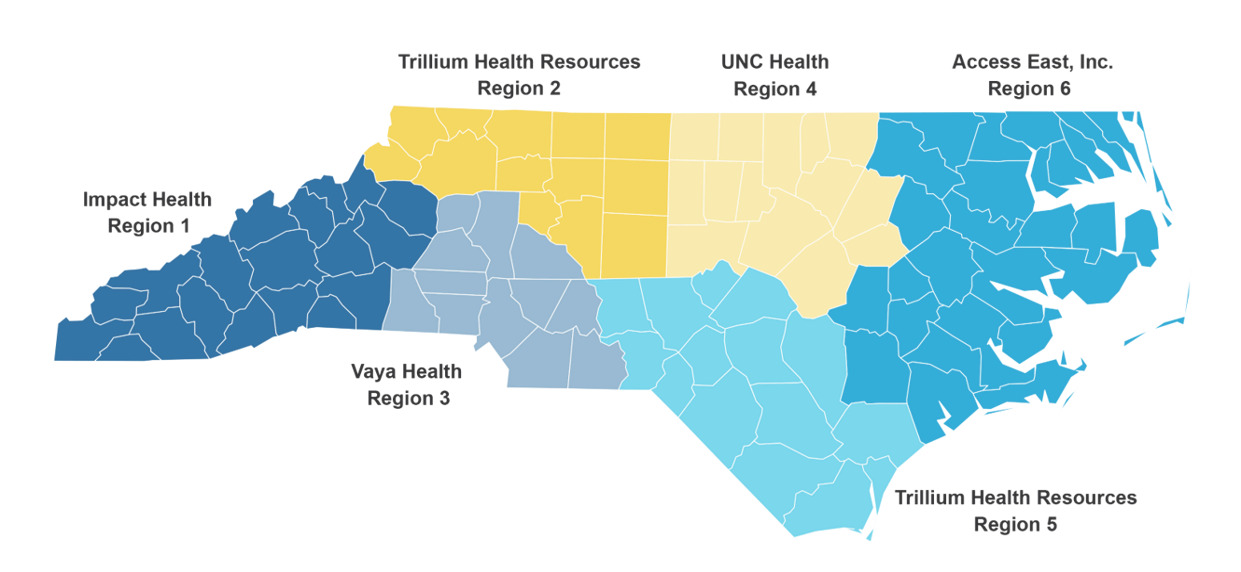
Each Hub Lead brings a distinct regional perspective shaped by local assets, needs, and community priorities. They represent organizations with unique history and perspective in the health care system in North Carolina, allowing sharing of perspectives across organizations.
-
Impact Health – Region 1
-
Trillium Health Resources – Regions 2 and 5
-
Vaya Health – Region 3
-
UNC Health – Region 4
-
Access East, Inc. – Region 6
These approaches, whether provider-anchored, community-led, or coalition-driven, illustrate how North Carolina’s RHTP statewide framework enables flexible, locally governed models that strengthen coordinated care across rural North Carolina.
Looking to the Future
As ROOTS Hubs continue strengthening governance and coordinated care across the six regions, North Carolina’s RHTP is focused on how these investments will endure beyond the 5-year funding and how statewide alignment can support rural communities for decades to come.
Rural Health Transformation represents one of the largest federal investments ever directed toward redesigning rural care delivery, offering the state a rare chance to build a sustainable, community-centered rural health system. Through the ROOTS model, North Carolina has crafted a roadmap that balances statewide consistency with regional flexibility, ensuring each community has the tools, infrastructure, and support needed to shape the future of care. Underlying the North Carolina RHTP strategy is the belief that understanding and implementing the changes that support true rural health transformation start with asking the people who live and work in rural areas what their communities need, and supporting them with the tools, infrastructure, and funding to work together to create the future of care.
North Carolina’s RHTP is not a standalone initiative; it must operate within a broader ecosystem of rural health efforts, especially as policy changes such as H.R. 1 may constrain resources available to many communities16–18 Aligning North Carolina’s RHTP with existing federal and state investments—including FQHCs, critical access hospitals, the Rural Hospital Flexibility Grant Program (Flex) and Small Rural Hospital Improvement Grant Program (SHIP), provider loan repayment initiatives, and HOP—will be essential to maximizing access and strengthening the rural care foundation. ROOTS Hubs and related components of North Carolina’s RHTP offer a structure for coordinating these efforts and ensuring they reinforce rather than duplicate one another.
North Carolina’s RHTP must also integrate closely with statewide efforts to improve how care is paid for and to make care more affordable. Governor Josh Stein’s Health Care Affordability Commission provides a platform for identifying strategies to reduce costs for North Carolinians,19 and NCRHTP offers a real-world environment to test and implement these recommendations in rural contexts.
By aligning and evaluating complementary payment and financing approaches, including value-based models, CMS participation, and multi-payer strategies, North Carolina can support long-term sustainability while expanding access, improving quality, and making care more affordable.
North Carolina’s RHTP is planting the seeds for a transformed rural health system, one that strengthens coordination among providers, brings care closer to home, and supports sustainable models that will enhance rural health for decades to come.
Acknowledgments
The authors thank the North Carolina ROOTS Hub Lead organizations, Impact Health, Trillium Health Resources, Vaya Health, UNC Health, and Access East, Inc. for their partnership and for sharing insights on regional needs, priorities, and planned approaches to governance and coordinated care. The authors also appreciate contributions from colleagues across the North Carolina Department of Health and Human Services and Duke-Margolis Center for Health Policy who supported evidence review and policy analysis for this commentary.
Funding
Stevens Amendment Disclosure: This article is supported by the Centers for Medicare and Medicaid Services (CMS) of the U.S. Department of Health and Human Services (HHS) as part of a financial assistance award totaling $213,008,356.47 with 100% funded by CMS/HHS. The contents are those of the author(s) and do not necessarily represent the official views of, nor an endorsement by, CMS/HHS or the U.S. Government.
Conflicts Of Interest
The authors report no conflicts of interest.
Correspondence
Address correspondence to Maggie Woods (Maggie.Woods@dhhs.nc.gov).